
Bengaluru’s BEML Aditya plant to manufacture India’s first bullet train ‘B28’
Context
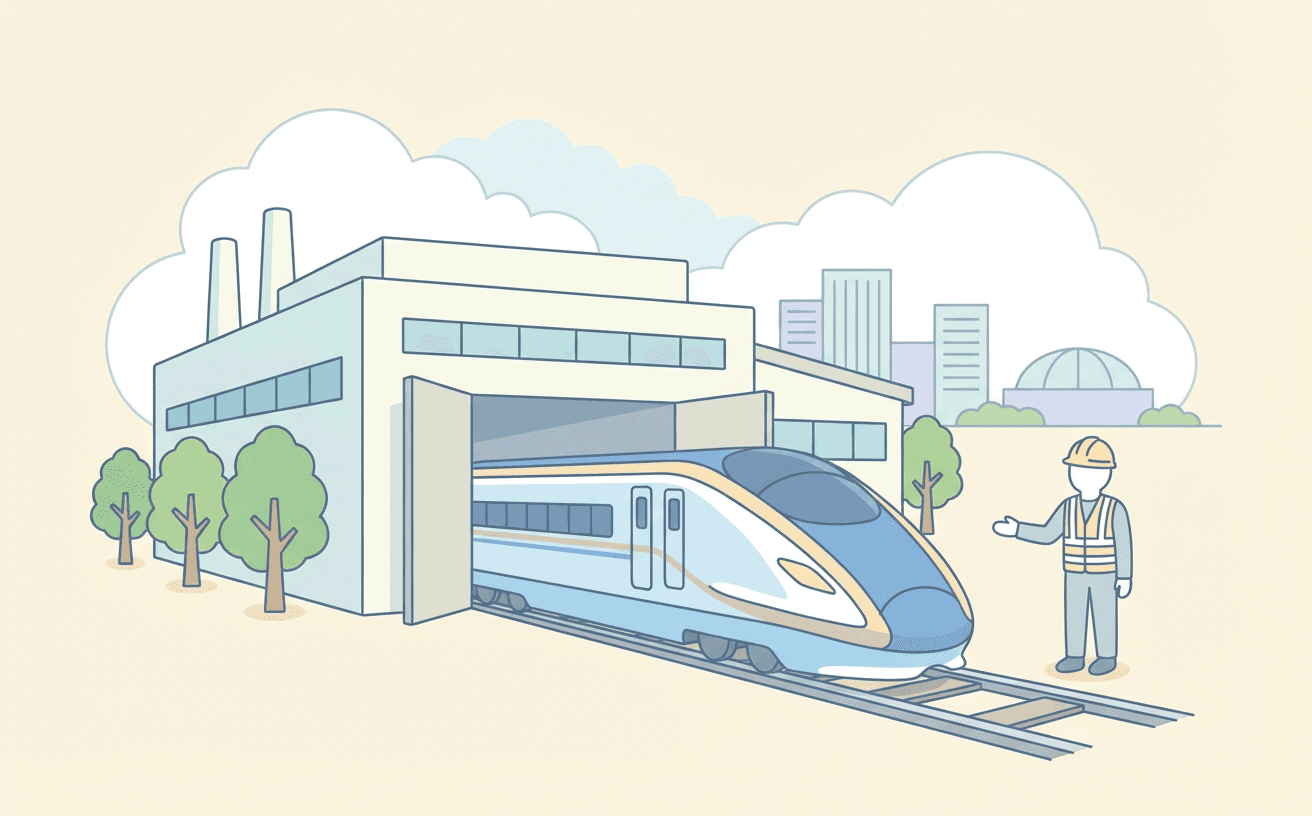
The has inaugurated the 'Aditya' manufacturing complex at in Bengaluru to develop India's first indigenous bullet train, the 'B28'. Contracted by the , this project aims to deploy Bharat-made high-speed trainsets capable of 280 kmph by March 2027. The first B28 trains are slated to operate on the 97-km Surat-Vapi stretch of the , targeted for launch in August 2027.
Exam perspectives
The development of the B28 trainset represents a watershed moment for the Make in India initiative and the broader goal of Atmanirbhar Bharat (self-reliant India). Originally, the Mumbai-Ahmedabad High-Speed Rail Corridor was highly reliant on imported Japanese E5 Series Shinkansen technology, but cost escalations and delivery timelines prompted a strategic pivot toward indigenous manufacturing. By awarding the ₹866 crore developmental contract to the defense public sector unit BEML via the Integral Coach Factory, the government is curbing massive foreign exchange outflows while incubating a domestic high-tech supply chain. This shift structurally transforms India from a technology importer to a self-reliant manufacturer, fundamentally lowering the capital expenditure (CAPEX) required for future high-speed rail expansions across the country.
Building high-speed rolling stock involves immense engineering complexity, requiring mastery over aerodynamics, lightweight bogie design, and precision safety protocols. The B28 is engineered with a structural design speed of 280 kmph and an operational speed of 250 kmph, bridging the technological gap between the semi-high-speed Vande Bharat trains (160 kmph) and ultra-high-speed international transit. For the Ministry of Railways, this project ensures vital technology absorption in advanced domains like the Train Control Management System (TCMS) and Automated Emergency Braking. Furthermore, successfully manufacturing and integrating these indigenous trains with next-generation automated signaling systems demonstrates a massive leap in India's sovereign engineering capacity and institutional knowledge.
High-Speed Rail (HSR) acts as a powerful catalyst for agglomeration economics, a phenomenon where shrinking the temporal distance between distinct urban nodes creates highly unified, productive labor and commercial markets. The debut of the B28 on the Surat-Vapi stretch will seamlessly integrate Gujarat's regional industrial clusters into a cohesive mega-economic corridor. While the broader civil construction of the corridor is heavily funded by a soft loan from the Japan International Cooperation Agency, pairing it with domestic rolling stock ensures sovereign control over service scalability. For UPSC aspirants, this illustrates how transport infrastructure functions as a spatial multiplier, driving Transit-Oriented Development (TOD) and enabling tier-2 cities to thrive as extensions of massive urban hubs like Mumbai and Bengaluru.
Key references
AI-generated study notes, sourced from Indian Express. Verify facts and figures with standard sources.