
Indian Ocean Dipole: What is it, and can it rescue India’s faltering 2026 monsoon
Context
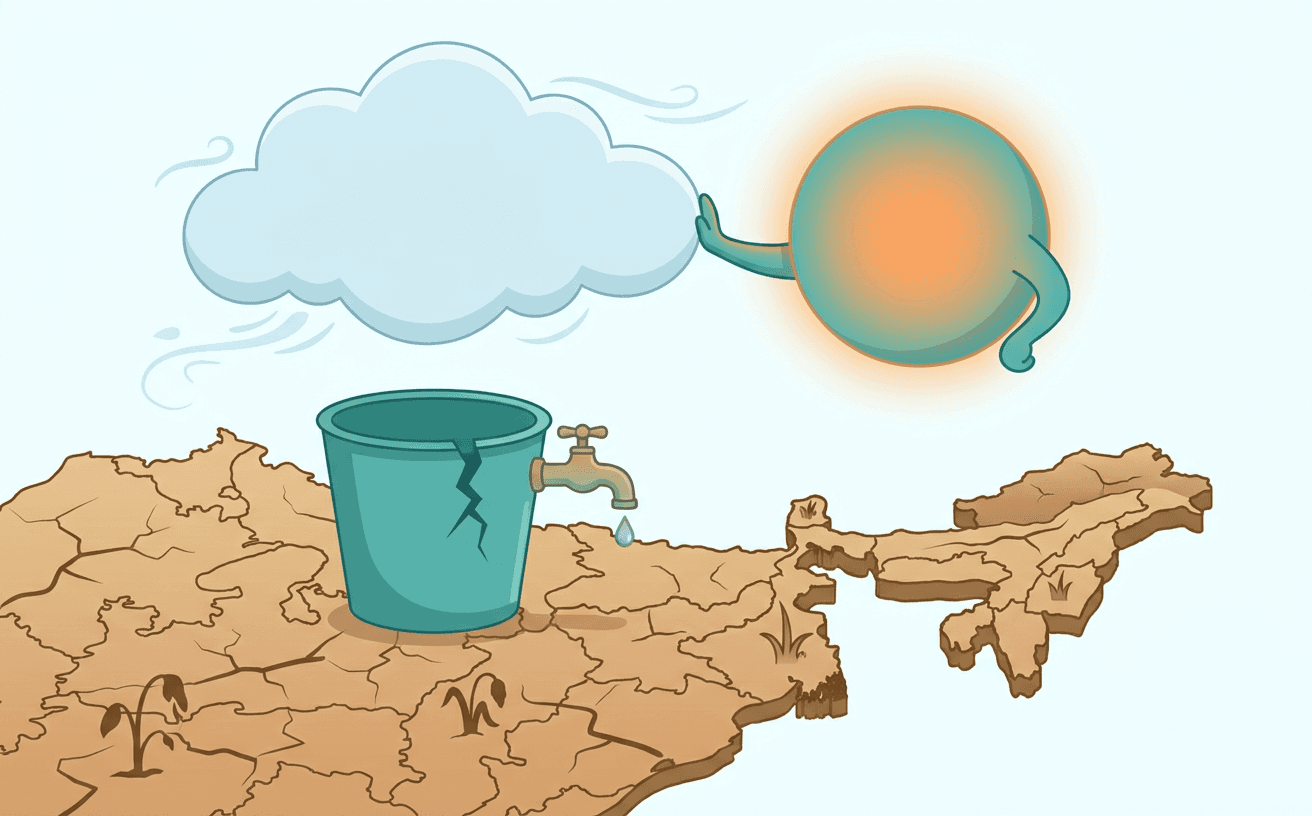
The 2026 Southwest Monsoon arrived late, accompanied by a significant rainfall deficit of 40% in June, primarily affecting central, eastern, and north-eastern India. While strengthening El Niño conditions threaten to further suppress rainfall, meteorologists are looking towards the potential development of a positive Indian Ocean Dipole (IOD) to mitigate the shortfall, highlighting the complex interplay of global oceanic phenomena on India's climate.
Exam perspectives
Understanding the monsoon requires analyzing global oceanic-atmospheric phenomena. El Niño, a warming of the central and eastern equatorial Pacific Ocean, shifts heat into the atmosphere, disrupting trade winds and typically leading to weaker monsoon rainfall over India. The Niño3.4 index monitors these sea surface temperature anomalies. The article highlights the Madden-Julian Oscillation (MJO), an eastward-moving 'pulse' of clouds and wind that can enhance or suppress rainfall depending on its geographical phase (1-8). Crucially, the Indian Ocean Dipole (IOD), an ocean-atmosphere interaction confined to the Indian Ocean, acts as a wild card. A positive IOD, characterized by warmer western Indian Ocean waters relative to the east, pushes moisture towards East Africa and India, potentially boosting rainfall and offsetting El Niño's negative impacts, as seen in 1997 and 2019.
The volatility of the monsoon, driven by the interplay of El Niño and the IOD, underscores the increasing complexity of climate forecasting. The delayed onset and significant June deficit highlight the vulnerability of Indian agriculture to climate variability. The India Meteorological Department (IMD) plays a crucial role in monitoring these complex interactions. The conflicting forecasts regarding the IOD (neutral vs. positive) from the IMD and Australia’s Bureau of Meteorology demonstrate the inherent uncertainty in predicting these coupled oceanic-atmospheric systems. This unpredictability necessitates robust climate adaptation strategies to mitigate the impacts of potential droughts or floods.
The performance of the Southwest Monsoon is intrinsically linked to India's macroeconomic stability. A 40% rainfall deficit in June, particularly in central and eastern states, directly impacts the sowing of Kharif crops (summer-sown crops like rice, maize, cotton). This threatens agricultural output, which can lead to lower rural incomes, dampening rural demand for manufactured goods and services. A prolonged dry spell can trigger food inflation, complicating the monetary policy stance of the Reserve Bank of India (RBI). The potential for a positive IOD to rescue the monsoon is thus a critical factor for agricultural economists and policymakers, as it dictates the trajectory of agricultural growth and overall economic resilience.
Key references
AI-generated study notes, sourced from Indian Express. Verify facts and figures with standard sources.