
What did the Supreme Court say about bail under UAPA?
Context
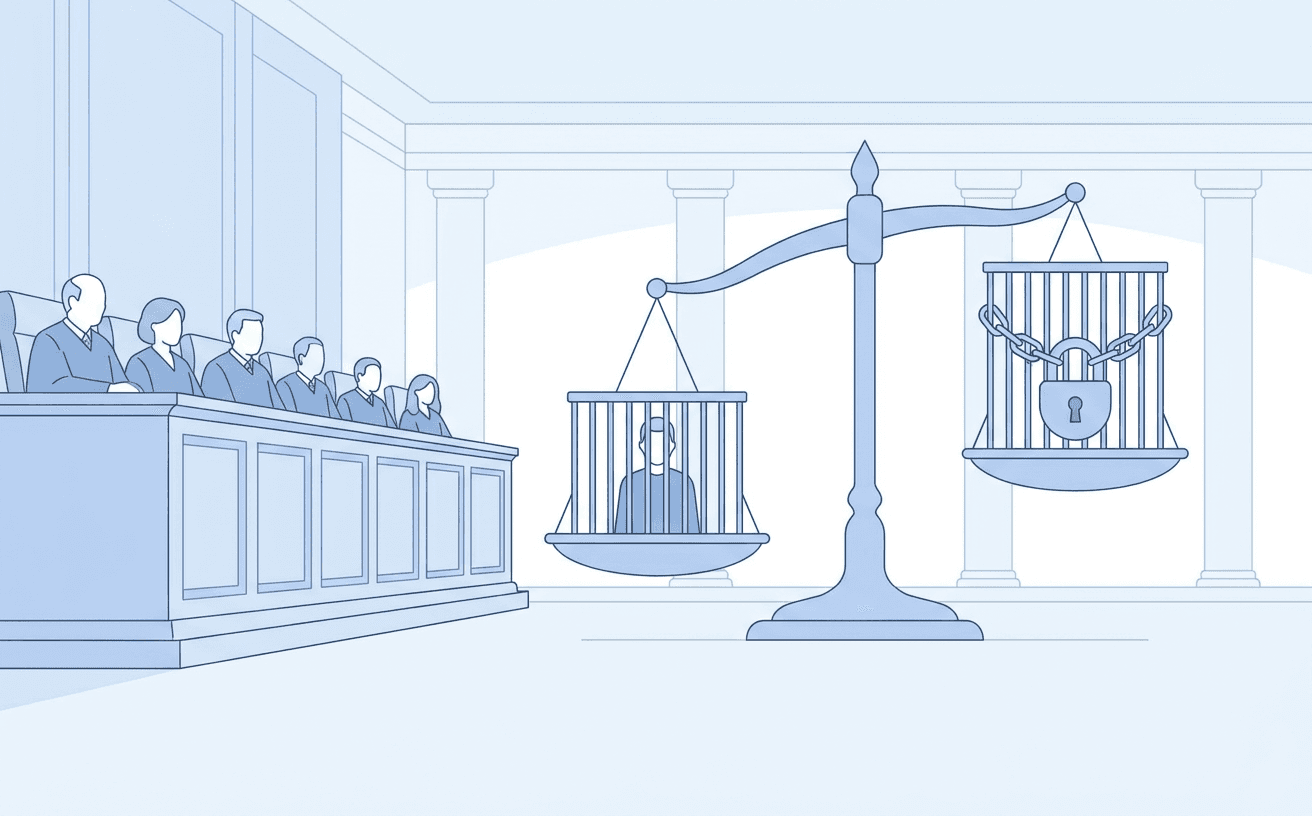
The has referred to a larger Bench the crucial question of whether prolonged pre-trial incarceration and trial delays can override the stringent bail conditions under the (UAPA). This follows conflicting interpretations by smaller Benches regarding the application of the landmark 2021 judgment, which had ruled that constitutional courts could grant bail despite statutory restrictions if the fundamental right to a speedy trial was violated.
Exam perspectives
This issue centers on the conflict between statutory law and constitutional rights. The Unlawful Activities (Prevention) Act, 1967 contains a stringent provision, Section 43D(5), which effectively reverses the normal jurisprudence of 'bail, not jail'. Under this section, bail is denied if the court finds 'reasonable grounds' to believe the accusations are prima facie true, placing a heavy burden on the accused. The 2019 NIA v. Zahoor Ahmad Shah Watali judgment further narrowed the scope for bail by ruling that courts need not conduct an 'elaborate examination' of evidence, only a glance at 'broad probabilities'. This statutory embargo creates a tension with Article 21 of the Constitution, which guarantees the fundamental right to life and personal liberty, encompassing the right to a speedy trial. The 2021 Union of India v. K.A. Najeeb judgment attempted to harmonize this by ruling that constitutional courts could 'melt down' the rigour of Section 43D(5) if prolonged incarceration without a trial violated Article 21. The current controversy highlights the challenges lower courts face in applying this principle consistently, leading the Supreme Court to seek a definitive ruling from a larger Bench.
The debate touches upon the balance between state security interests and individual liberties in the administration of criminal justice. The state often relies on stringent laws like the Unlawful Activities (Prevention) Act, 1967 to combat terrorism and protect national security. The government argues, as seen in the Additional Solicitor General's submissions, that the gravity of terror charges should outweigh claims for bail based solely on delay. However, this approach risks converting pre-trial detention into punishment, especially when considering the low conviction rate under UAPA (reported as 2-6%). The Syed Iftikhar Andrabi v. NIA judgment emphasized that the state cannot punish an undertrial by denying bail due to its own 'ineptitude to hold a trial on time'. If an offense is serious, the prosecution must ensure a speedy trial. This raises crucial governance questions about the efficiency of the investigative and judicial processes. A system where trial delays are endemic forces courts to intervene to protect fundamental rights, highlighting a failure in the state's capacity to deliver timely justice, which is a core component of the rule of law.
The application of the Unlawful Activities (Prevention) Act, 1967 is a critical component of India's internal security framework. The law is designed to tackle terrorism and unlawful activities that threaten the sovereignty and integrity of India. The stringent bail conditions under Section 43D(5) are intended to prevent individuals accused of serious terror offenses from returning to society and potentially resuming their activities while awaiting trial. The government frequently uses the argument that the nature of these crimes—such as larger conspiracies—requires a different standard for bail. However, the broad definition of 'terrorist act' and the power to designate individuals as terrorists under the UAPA have led to concerns about the misuse of the law to stifle dissent. The ongoing legal debate reflects the complex challenge of ensuring robust legal tools to combat genuine security threats without compromising essential democratic principles and civil liberties. The upcoming larger Bench decision will be pivotal in defining the limits of the state's power to detain individuals indefinitely under anti-terror legislation.
Key references
AI-generated study notes, sourced from The Hindu. Verify facts and figures with standard sources.