
3D concrete printing houses breaking ground in Andhra Pradesh | Explained
Context
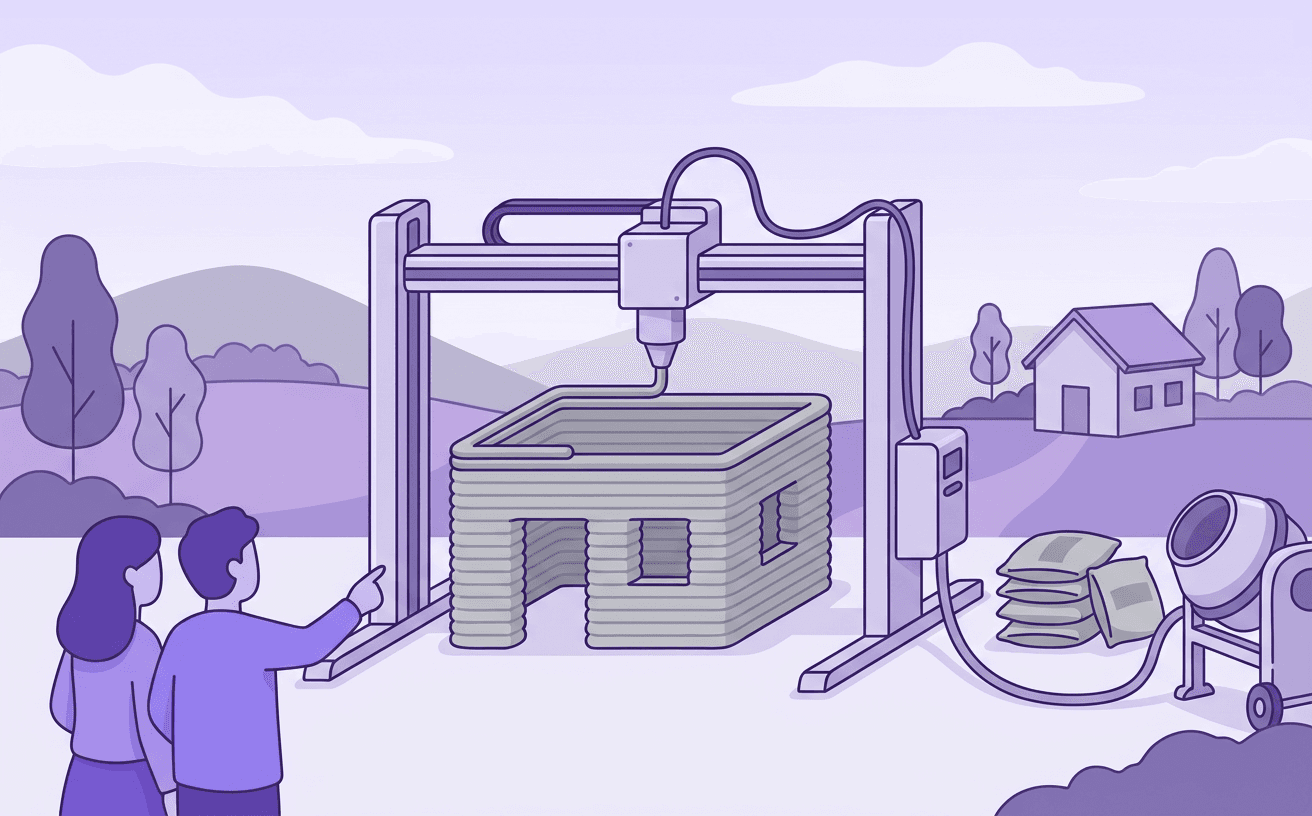
Andhra Pradesh has launched a national-level pilot project to construct rural homes using 3D Concrete Printing (3DCP) technology under the (PMAY-G) scheme. This initiative, starting in Guntur district, represents a significant shift towards automated construction in India, aiming to address critical infrastructure and affordable housing needs through innovative technology.
Exam perspectives
The adoption of 3D Concrete Printing (3DCP), a form of construction-scale additive manufacturing, marks a significant advancement in India's technological capabilities. This process replaces traditional masonry by using a computer-controlled robotic printer to extrude specially formulated cementitious materials layer by layer, based on a digital Building Information Modelling (BIM) design. The success of 3DCP relies on advanced material science to ensure the concrete mix maintains exact extrudability, buildability, and rapid setting times without structural collapse. While India saw early domestic success with a prototype by IIT Madras and startup Tvasta, scaling this up for national schemes requires rigorous validation of material durability, structural integrity, and compliance with stringent building codes. For UPSC, candidates must understand how emerging technologies like 3D printing, AI, and robotics can be integrated into traditional civil engineering to revolutionize infrastructure development, particularly in disaster-prone or remote areas.
The integration of 3DCP into the Pradhan Mantri Awas Yojana-Gramin (PMAY-G) exemplifies a proactive governance approach to accelerating welfare delivery. By reducing construction time per unit to roughly 45-60 days, this technology directly addresses the challenge of timely execution in large-scale public housing missions. Furthermore, by minimizing reliance on localized masonry skills, it allows for standardized, high-speed construction in remote communities, fulfilling urgent public welfare demands more efficiently. However, the regulatory framework must evolve rapidly to accommodate these innovations. The involvement of bodies like the CSIR-Central Building Research Institute highlights the necessary collaboration between academic research, private innovators, and central/state ministries to establish long-term structural reliability and economic viability. UPSC Mains questions may focus on how technology can enhance the efficacy of government schemes and the regulatory challenges associated with adopting disruptive technologies in public works.
From an economic perspective, 3DCP offers substantial benefits in terms of resource efficiency and reduced material waste, which is crucial for sustainable infrastructure development. The elimination of traditional timber or steel formwork significantly lowers associated costs and environmental impact. The pilot project in Andhra Pradesh, funded jointly by the Ministry of Rural Development and the state government, demonstrates the financial commitment required to transition from experimental phases to commercial deployment. While the initial capital expenditure for 3D printers and specialized materials may be high, the long-term economic viability hinges on economies of scale, reduced labor dependencies, and faster project completion rates. For UPSC, the focus should be on evaluating the cost-benefit analysis of adopting additive manufacturing in addressing critical infrastructure shortages, promoting affordable housing, and potentially creating a new ecosystem of specialized technical jobs while disrupting traditional construction labor markets.
Key references
AI-generated study notes, sourced from The Hindu. Verify facts and figures with standard sources.