
Anti-CEC protest LIVE | Supreme Court issues notices on protest-related petitions, seeks reasons behind prohibitory orders from government
Context
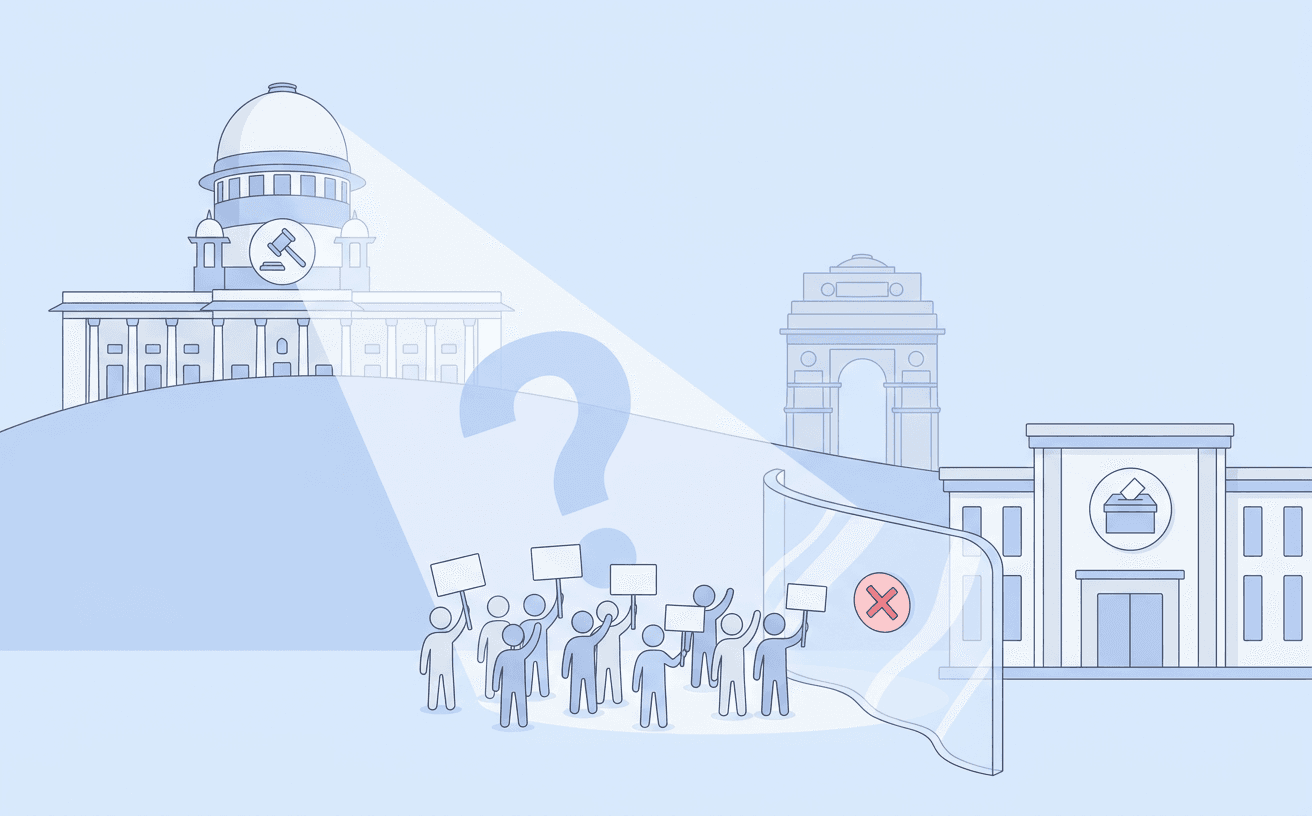
The has intervened in ongoing protests in Delhi against the (CEC), issuing notices regarding the imposition of prohibitory orders under Section 163 of the (BNSS). The court is addressing multiple petitions concerning alleged police brutality, harassment of women journalists, and the unauthorised seizure of electronic devices, highlighting the friction between state security measures and fundamental rights.
Exam perspectives
The central constitutional issue revolves around the balance between maintaining public order and upholding the fundamental right to assemble peacefully under Article 19(1)(b) and freedom of speech under Article 19(1)(a). The Supreme Court's scrutiny of the prohibitory orders under Section 163 of the Bharatiya Nagarik Suraksha Sanhita (BNSS) (which replaced Section 144 of the CrPC) underscores the principle of proportionality. The state must demonstrate that restricting movement and assembly is a necessary and proportionate response to a genuine threat to public order, not merely a tool to stifle dissent. The court's demand for the 'reasons and circumstances' behind these orders emphasizes that executive action must be transparent and legally justifiable. Furthermore, the allegations regarding the Chief Election Commissioner (CEC) touch upon concerns about the independence of constitutional bodies, a critical pillar of India's democratic framework. UPSC aspirants should analyze the evolution of jurisprudence around Section 144/163 and the ongoing debates regarding the appointment process of the CEC.
The allegations of police misconduct and the unauthorized seizure of journalists' devices raise significant questions about police accountability and the protection of civil liberties. The Delhi Union of Journalists arguing that device seizure affects livelihood invokes Article 21 (Right to Life and Personal Liberty). The court's observation that there should be no unauthorized seizure highlights the lack of clear, statutory guidelines governing digital searches, an area currently under judicial scrutiny in other cases as well. The state's defense, suggesting that videos of harassment might be AI-generated (deepfakes), introduces the complex challenge of regulating emerging technologies in legal proceedings and evidence gathering. This necessitates an examination of the Information Technology Act, 2000 and the need for updated legal frameworks to address digital evidence. From a governance perspective, the focus should be on establishing robust mechanisms to oversee law enforcement agencies and ensuring that digital rights are protected against arbitrary state action.
The specific allegations of harassment faced by women journalists and the intervention by the Network of Women in Media, India (NWMI) bring to light the gendered risks inherent in public spaces and conflict reporting. The Supreme Court's preliminary agreement to form a committee headed by a woman, potentially an SC judge, referencing the Vishaka Guidelines, represents an attempt to create a specialized mechanism for addressing sexual harassment outside traditional workplace settings. This highlights the ongoing challenge of ensuring safety and dignity for women exercising their professional duties in hostile environments. Additionally, the invocation of the Scheduled Castes and Scheduled Tribes (Prevention of Atrocities) Act in an FIR against a journalist underscores the complex interplay of caste dynamics within conflicts between citizens and law enforcement. Aspirants should understand how legal frameworks designed for protection, like the SC/ST Act and workplace harassment guidelines, intersect with issues of freedom of expression and police conduct.
Key references
AI-generated study notes, sourced from The Hindu. Verify facts and figures with standard sources.