
ASI begins drilling into Konark Sun Temple to remove 100-year-old British-era sand
Context
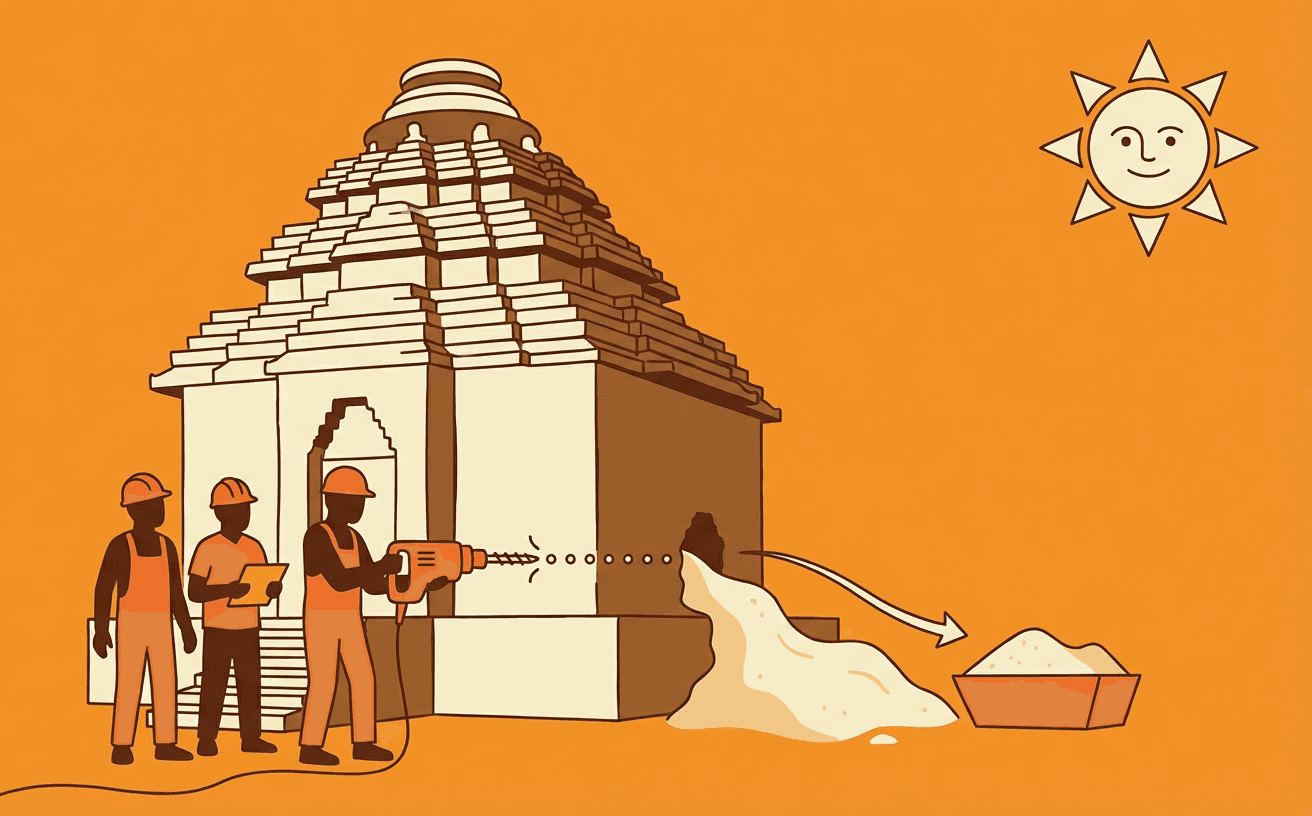
The () has initiated the process of drilling a passage into the Jagamohan (assembly hall) of the 13th-century in Odisha. This is to remove sand packed inside by the British administration between 1901 and 1903 to prevent the structural collapse of the monument. The delicate operation involves using diamond drilling technology to ensure the stability of the .
Exam perspectives
The Konark Sun Temple, built in the 13th century by King Narasimhadeva I of the Eastern Ganga dynasty, represents the pinnacle of Kalinga architecture. It is designed as a colossal chariot for the Sun God (Surya), complete with 24 carved wheels and seven horses. The temple complex originally consisted of a main sanctum (Vimana), which has collapsed, and an assembly hall (Jagamohan), which is currently filled with sand. The structure is built primarily of khondalite stones, a type of metamorphic rock common in the Eastern Ghats. This news highlights the vulnerability of such structures to natural elements and the ongoing efforts required for their preservation. For UPSC, candidates must know the temple's architectural features, its historical context, and the materials used in its construction.
The conservation of ancient monuments poses a complex challenge balancing structural stability with preserving originality. The British decision to fill the Jagamohan with sand was a rudimentary but necessary step at the time to prevent a total collapse. However, as noted by former ASI DG Debala Mitra in the 1950s, this led to new issues like rainwater seepage and moss growth. The current operation by the Archaeological Survey of India demonstrates the evolution of conservation techniques, employing non-destructive methods like diamond drilling and preliminary sample analysis by institutions like the Indian Institute of Technology Madras. This reflects a modern, scientific approach to heritage management. UPSC questions may focus on the role of the ASI, challenges in monument conservation (e.g., weathering, structural instability), and the legal framework protecting heritage sites like the Ancient Monuments and Archaeological Sites and Remains Act.
The Konark Sun Temple is not just a religious site but a testament to the naval and economic power of the Eastern Ganga dynasty, often referred to as 'Black Pagoda' by European sailors because of its dark color and use as a navigational landmark. It was a major center for the worship of Surya in India, alongside others like Modhera in Gujarat and Martand in Kashmir. The scale of the construction, reportedly involving 1,200 sculptors over 12 years, reflects the state capacity and patronage of the arts during that era. Understanding the political and economic context of such monumental architecture is crucial for the History syllabus. The UNESCO World Heritage Site designation underscores its outstanding universal value, making it a recurring theme in Prelims and Mains.
Key references
AI-generated study notes, sourced from Indian Express. Verify facts and figures with standard sources.