
Bengaluru scientists decode solar eruptions using Aditya-L1 and Proba-3 satellites
Context
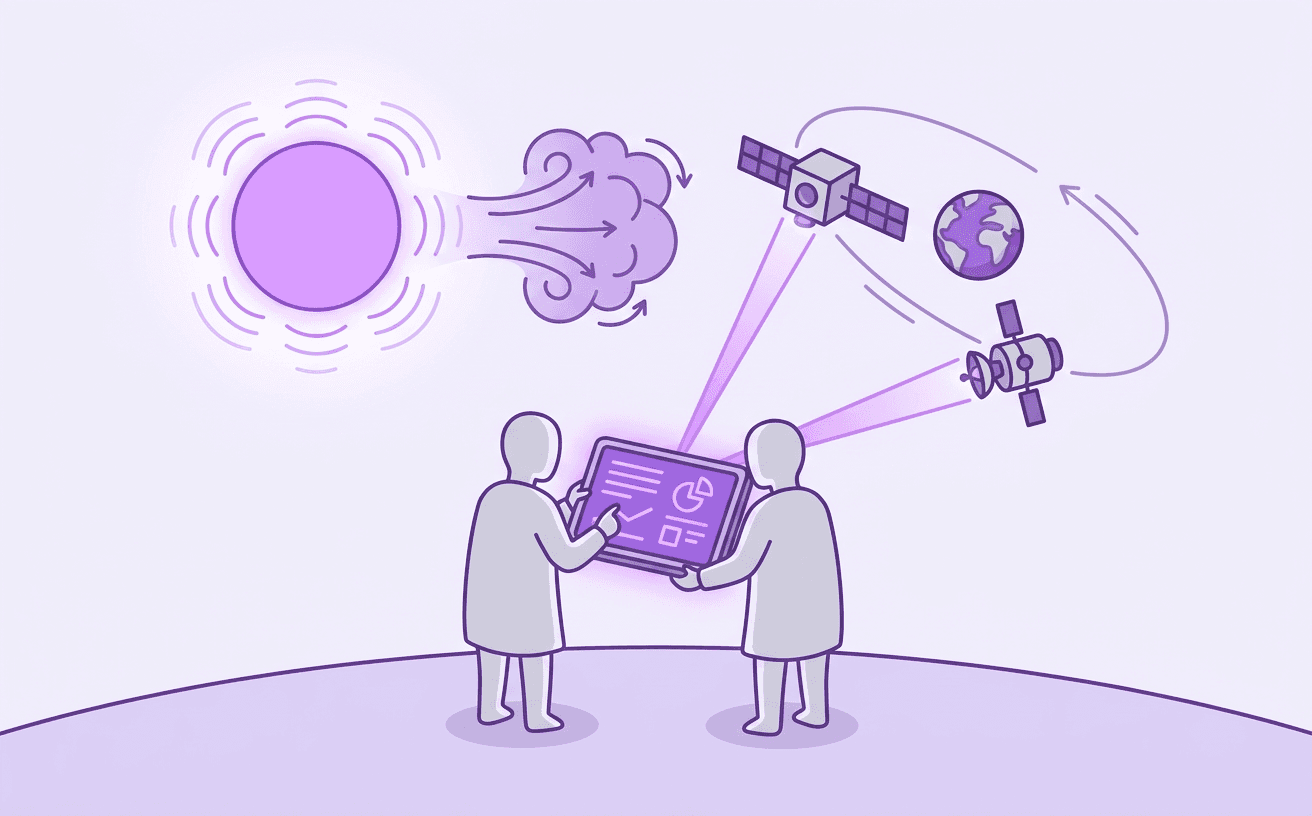
Scientists from the have successfully analyzed Coronal Mass Ejections (CMEs) by combining data from India's mission and the European Space Agency's (ESA) mission. This joint observation, utilizing different types of instruments on the two satellites, provided unprecedented insights into the early evolution, mass, density, and energetics of CMEs close to the Sun.
Exam perspectives
This development highlights the significance of synergistic space observations in advancing solar physics. The Aditya-L1 mission, launched by ISRO in 2023, is positioned at the Lagrange Point 1 (L1) to continuously observe the Sun without occultation. Its Visible Emission Line Coronagraph (VELC) provided spectroscopic data, detailing the gas temperature (thermal energy) of the CMEs. Concurrently, the ESA's Proba-3 mission, a unique two-satellite formation flying project where one satellite casts a shadow on the other to create an artificial eclipse, used its ASPIICS payload for high-resolution imaging. ASPIICS provided crucial data on the shape, dynamics, and mass of the CMEs. By combining spectroscopic analysis (measuring the spectrum of light to determine chemical composition and physical properties) with direct imaging, scientists cross-verified and enhanced the accuracy of their estimates regarding CME density and thermal energy. This multi-instrument approach is crucial because it compensates for the inherent limitations of single-spacecraft observations, offering a more comprehensive understanding of complex space weather phenomena.
Understanding Coronal Mass Ejections (CMEs) is vital for space weather forecasting, which has direct implications for Earth's technological infrastructure. CMEs are massive bursts of solar wind and magnetic fields rising above the solar corona or being released into space. When directed toward Earth, these events can cause geomagnetic storms. These storms can disrupt satellite operations, impacting navigation systems like GPS and communication networks. Furthermore, severe geomagnetic storms can induce strong electrical currents in power grids on Earth, potentially leading to widespread blackouts. The study's ability to track the early evolution of CMEs—such as distinguishing between fast (645 km/s) and slow (145 km/s) CMEs and analyzing their varying energy dynamics (thermal vs. kinetic vs. magnetic energy)—is critical for developing early warning systems. Improved forecasting allows operators to take protective measures for satellites and power grids, mitigating the risks associated with extreme space weather events.
The success of this joint study underscores the critical importance of international collaboration in space exploration. Space missions, especially complex ones like Proba-3 and deep-space observatories like Aditya-L1, require immense financial resources and technological expertise. By sharing data and combining the unique capabilities of their respective instruments, ISRO and the European Space Agency (ESA) are maximizing the scientific return on investment for both agencies. This collaborative framework, fostered by institutions like the Indian Institute of Astrophysics (IIA), is essential for tackling complex global challenges, such as understanding space weather, which affects all nations relying on space-based assets. From a UPSC perspective, this highlights India's growing role as a reliable partner in global scientific endeavors and demonstrates how science diplomacy can enhance a nation's soft power while advancing critical research.
Key references
AI-generated study notes, sourced from The Hindu. Verify facts and figures with standard sources.