
Bird islands: On India’s bustard conservation programme
Context
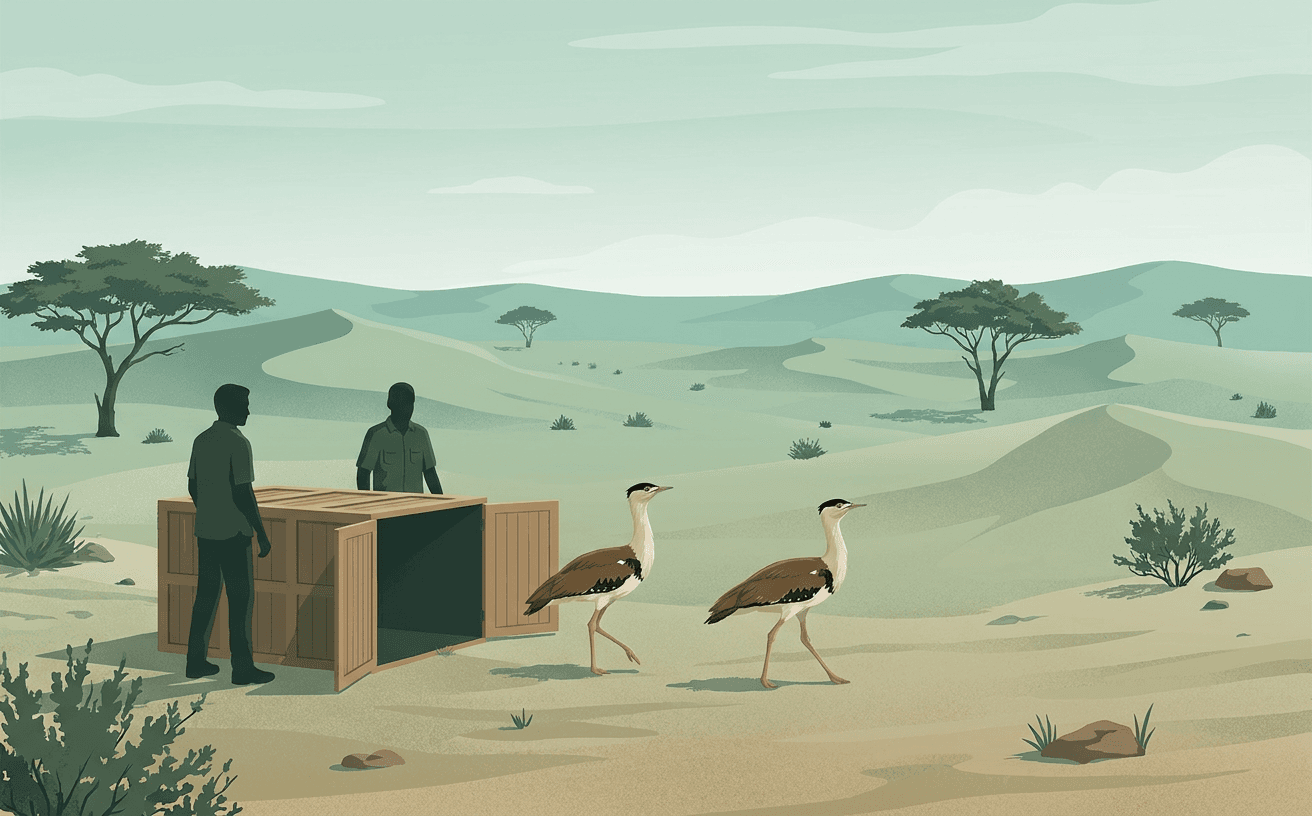
Two male s were released into the wild at the in , marking a significant step in the conservation program for the critically endangered species. The article critiques India’s current conservation approach, arguing it overly relies on symbolism and captive breeding ('islands of conservation'), and advocates for a shift towards landscape-level conservation strategies.
Exam perspectives
The Great Indian Bustard (GIB), locally known as 'Godawan', is an indicator species for grassland ecosystems. Its population has plummeted from over 1,200 in the 1960s to around 120 today, primarily due to habitat loss and degradation. Historically, grasslands were misclassified as 'wastelands' in Indian land-use policy, leading to their conversion into agricultural fields or infrastructure projects. The expansion of irrigation networks in Rajasthan has transformed dry habitats into pesticide-heavy fields, negatively impacting the GIB's food sources. Furthermore, the GIB faces a severe threat from collisions with high-tension power lines, primarily associated with renewable energy projects (solar and wind) in its habitat. The species is listed as 'Critically Endangered' on the IUCN Red List, in Schedule I of the Wildlife Protection Act, 1972, and in Appendix I of CITES. The successful captive breeding program, while commendable, highlights the limitations of focusing solely on population numbers if the habitat itself remains degraded or dangerous.
The editorial highlights a critical flaw in India's conservation policy: an over-reliance on symbolism and fragmented, enclosure-based conservation ('island' conservation) rather than addressing broader ecological connectivity. The article cites examples like moving tigers to Buxa Tiger Reserve, introducing African cheetahs, and confining lions to the Saurashtra region. This approach often ignores the ecological carrying capacity of these isolated reserves, leading to human-wildlife conflict when animal populations expand beyond park boundaries, as seen with elephants. True conservation requires a landscape-level approach, integrating protected areas with surrounding human-dominated landscapes (buffer zones and corridors) to ensure genetic exchange and long-term survival. This necessitates multi-departmental coordination (forest, agriculture, energy) rather than siloed actions by the forest department alone.
The conflict between conservation and development is clearly illustrated by the Supreme Court of India's intervention regarding power lines in GIB habitats. In 2021, the Court initially ordered the undergrounding of all low-voltage lines in priority habitats to prevent bird collisions. This order underscores the Court's application of the Precautionary Principle and the expansion of the Right to Life under Article 21 of the Constitution to include the protection of endangered species and their habitats. However, following pushback from the renewable energy sector—which argued that undergrounding lines would render solar projects economically unviable and hinder India's climate goals—the Court later modified its stance, requiring only lines within 'critical' habitats to be placed underground. This highlights the complex balancing act the judiciary faces between enforcing environmental laws and supporting infrastructure necessary for sustainable energy transitions.
Key references
AI-generated study notes, sourced from The Hindu. Verify facts and figures with standard sources.