
Climate change reshaping carbon storage in India’s forests: IITM-Pune study
Context
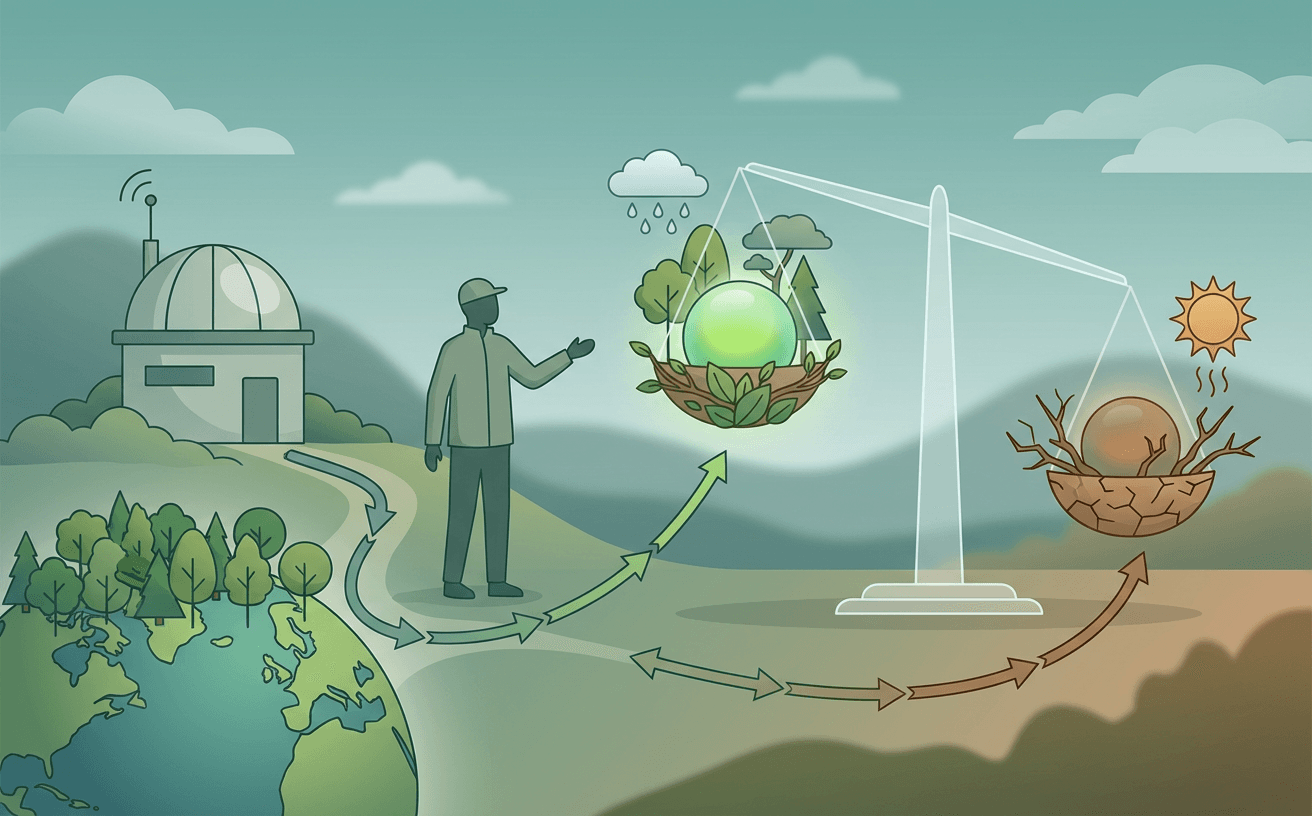
A new study by the (IITM-Pune) reveals that climate change is significantly altering the carbon storage capacity of India's forests. The research highlights a shift in forest dynamics, indicating that rising temperatures and changing precipitation patterns are negatively impacting the ability of these ecosystems to act as effective carbon sinks. This shift has critical implications for India's climate mitigation strategies and its international commitments.
Exam perspectives
The study underscores a critical feedback loop in climate science: as global temperatures rise due to greenhouse gas emissions, natural carbon sinks like forests become less effective, further exacerbating warming. Forests act as carbon sinks by absorbing carbon dioxide from the atmosphere during photosynthesis and storing it in biomass (trunks, branches, roots) and soil. The Indian Institute of Tropical Meteorology study suggests that climatic stressors—such as increased frequency of droughts and higher baseline temperatures—are increasing tree mortality and altering the composition of forest ecosystems in India. This reduces the net primary productivity of the forests, meaning they are absorbing less carbon than before. From a UPSC perspective, this directly impacts India's Nationally Determined Contributions (NDCs) under the Paris Agreement, specifically the commitment to create an additional carbon sink of 2.5 to 3 billion tonnes of CO2 equivalent through additional forest and tree cover by 2030. If existing forests are losing their storage capacity, achieving this target becomes significantly more challenging, necessitating a re-evaluation of current afforestation and conservation strategies like the National Mission for a Green India.
India's diverse geography supports a wide range of forest types, from the tropical wet evergreen forests of the Western Ghats to the alpine scrubs of the Himalayas. The impact of climate change on carbon storage is not uniform across these regions. The IITM study likely indicates that certain forest types are more vulnerable to changing climatic variables. For instance, deciduous forests, which cover a large part of peninsular India, may be particularly susceptible to altered monsoon patterns and prolonged dry spells, leading to increased fire risk and reduced biomass accumulation. Conversely, changes in temperature gradients could push certain species to higher altitudes in mountainous regions, disrupting established ecological niches. This regional variability is crucial for Mains answers in GS Paper 1 (Geography) when discussing the distribution of natural resources and the impact of climate change on flora. Understanding which specific forest biomes are most at risk allows for targeted adaptation measures. The changing dynamics also influence hydrological cycles, as forests play a vital role in regulating water flow and preventing soil erosion, impacting downstream water availability and agricultural productivity.
The findings present a significant challenge for environmental governance and policy formulation in India. Current forest management practices, guided by laws like the Forest Conservation Act, 1980 and the Indian Forest Act, 1927, primarily focus on preventing deforestation and promoting afforestation. However, the IITM study highlights the need for a paradigm shift towards climate-resilient forest management. This involves moving beyond merely increasing tree cover to ensuring the quality and resilience of that cover. Policies must incorporate scientific data to select tree species that are better adapted to projected future climates for plantation drives like Compensatory Afforestation Fund Management and Planning Authority (CAMPA) activities. Furthermore, this necessitates stronger integration between scientific research institutions like Indian Institute of Tropical Meteorology and policymaking bodies like the Ministry of Environment, Forest and Climate Change (MoEFCC). The governance challenge also extends to balancing developmental needs with conservation, as infrastructure projects often lead to forest fragmentation, which further degrades the ecosystem's resilience to climate stress. The ability of the state to enforce regulations and implement scientifically sound conservation strategies will be critical in mitigating the loss of carbon storage capacity.
Key references
AI-generated study notes, sourced from Indian Express. Verify facts and figures with standard sources.