
Expert Explains | Why the collapse of the AMOC ocean ‘conveyor belt’ could disrupt the Indian monsoon
Context
Recent research indicates that the (AMOC), a crucial system of global ocean currents, could weaken by up to 59% by 2100 due to climate change. This potential collapse of the oceanic 'conveyor belt' threatens to severely disrupt global weather patterns, including the vital Indian summer monsoon, thereby posing significant risks to India's agricultural sector and .
Exam perspectives
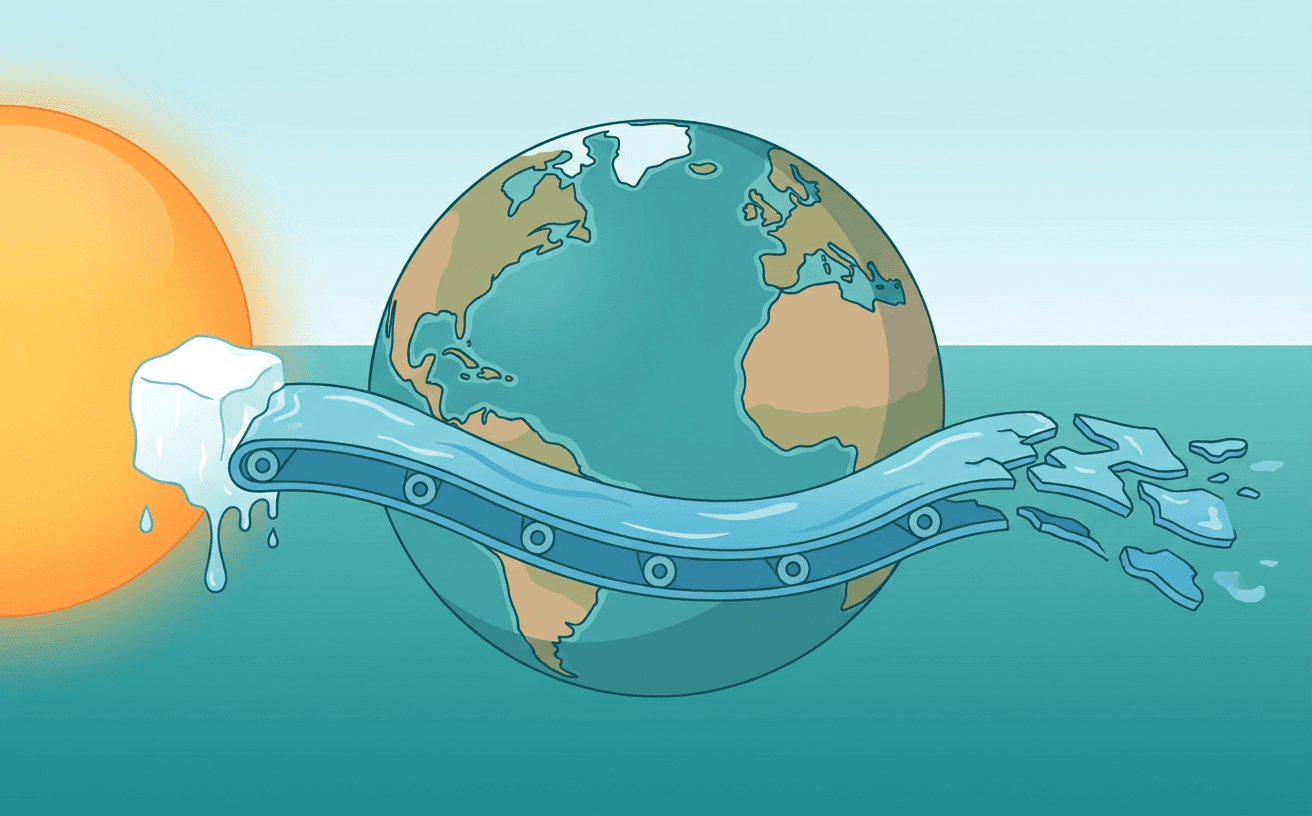
The Atlantic Meridional Overturning Circulation (AMOC) is a key component of the Earth's climate system, functioning as a massive oceanic conveyor belt. It transports warm, salty surface water from the tropics northward into the North Atlantic. Upon reaching the colder regions near Greenland, the water cools, increases in density, and sinks into the deep ocean (a process known as thermohaline circulation). This cold, deep water then flows southward, eventually resurfacing to complete the cycle. This global circulation of heat is critical; it is responsible for the relatively mild climate of Europe and influences rainfall patterns across Africa, the Americas, and Asia. However, the rapid melting of Arctic ice due to global warming is injecting large volumes of fresh water into the North Atlantic. This fresh water, being less dense than salty seawater, inhibits the sinking process, effectively acting as a brake on the entire AMOC system. If the AMOC crosses a critical tipping point, its collapse would lead to profound global geographical changes, including drastic shifts in regional temperatures and precipitation.
The weakening of the AMOC highlights the complex and interconnected nature of global environmental systems. While physically located in the Atlantic, a sluggish AMOC has severe ripple effects across the globe, particularly in the Pacific Ocean. A slowdown in the Atlantic conveyor belt alters global heat distribution, trapping more heat in the southern hemisphere and cooling the North Pacific. This temperature imbalance disrupts the mechanisms that drive the El Niño Southern Oscillation (ENSO). Studies suggest that a weaker AMOC will make El Niño events more unpredictable and extreme. Since El Niño is typically associated with suppressed rainfall and drought conditions over South Asia, this compounding effect presents a significant environmental threat. The situation exemplifies how a regional environmental change (Arctic ice melt) can trigger a systemic global crisis, emphasizing the necessity of viewing climate change through a holistic, earth-systems perspective.
The potential disruption of the Indian summer monsoon due to an AMOC collapse presents a severe threat to India's economic stability and food security. The monsoon is the lifeblood of Indian agriculture, providing crucial rainfall for crop production, which forms a significant portion of the country's GDP and employs roughly half of the workforce. If the AMOC slows down, less heat is transported north, causing the planet's tropical rain belt (the Intertropical Convergence Zone or ITCZ) to shift southward, away from the Indian subcontinent. This shift would significantly weaken the monsoon winds, leading to shorter wet seasons, prolonged dry spells, and an overall drying trend across India. Coupled with more erratic El Niño events, Indian farmers would face exacerbated risks of both extreme droughts and destructive floods. The resulting agricultural instability would have cascading effects on the rural economy, food prices, and national inflation, necessitating urgent policy interventions to build resilience in the agricultural sector.
Key references
AI-generated study notes, sourced from Indian Express. Verify facts and figures with standard sources.