
Home Secretary reviews Himalayan States’ preparedness for glacial lake outbursts
Context
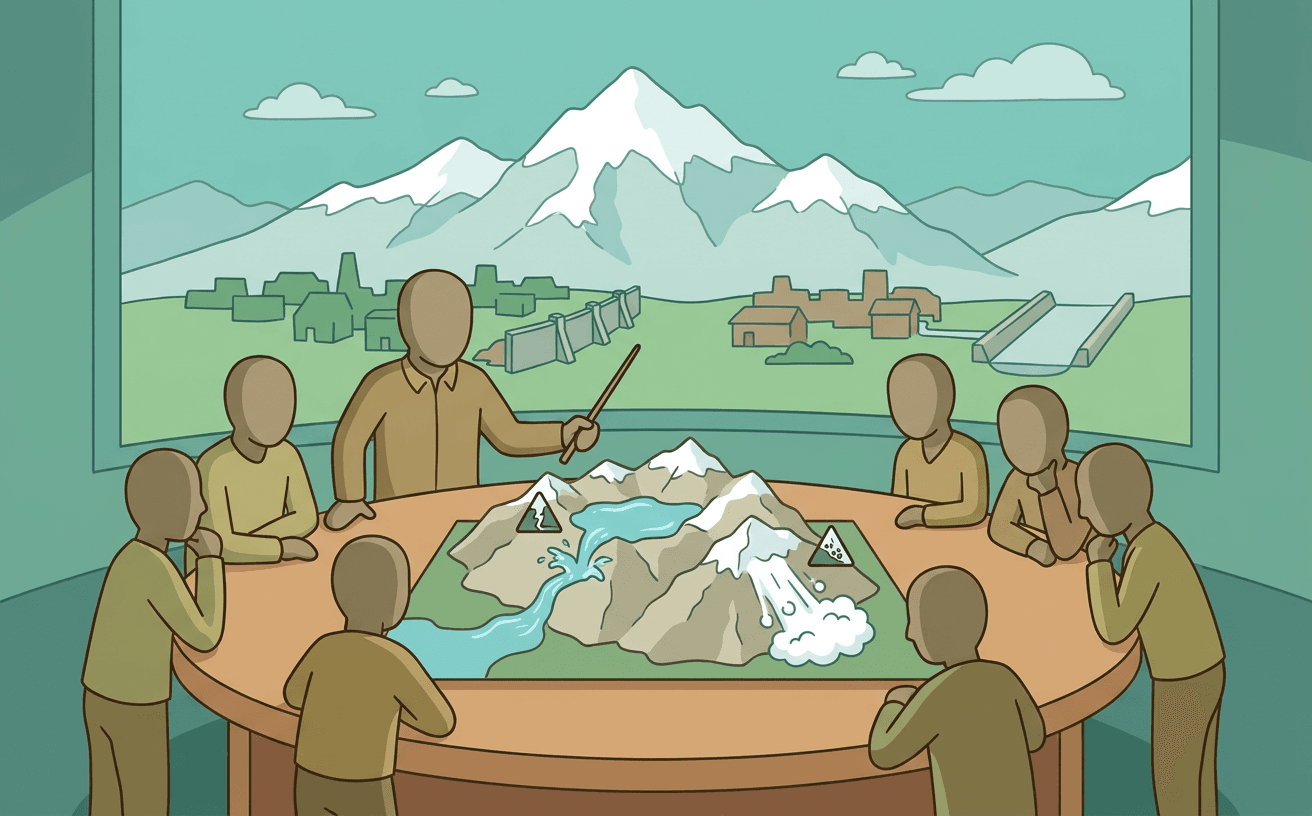
The Union Home Secretary chaired a review meeting with Himalayan States and Union Territories to assess preparedness for Glacial Lake Outburst Floods (GLOFs) and snow avalanches. Triggered by recent devastating flash floods in Nepal, the meeting emphasized shifting from a response-oriented approach to proactive monitoring, risk-informed planning, and strengthening early warning systems. The Centre also urged States to expedite the implementation of sanctioned in 2024.
Exam perspectives
A Glacial Lake Outburst Flood (GLOF) occurs when the dam containing a glacial lake fails, releasing a sudden, massive volume of water downstream. These dams, often formed by moraines (accumulations of dirt and rocks fallen onto the glacier surface), are inherently unstable. The rapid retreat of glaciers in the Himalayas due to global warming leads to the formation and expansion of these high-altitude lakes. When a trigger—such as an avalanche, heavy rainfall, or an earthquake—breaches the moraine dam, the resulting flash flood carries debris, mud, and boulders, causing catastrophic damage in valleys below. The Central Water Commission (CWC) and the Defence Geoinformatics Research Establishment (DGRE) play crucial roles in mapping these potential flow paths and identifying high-risk zones. For UPSC Mains, understanding the geomorphological processes forming these lakes and the climatic triggers for their outburst is essential for answering questions on Himalayan vulnerabilities in GS Paper 1.
Effective disaster management requires a transition from reactive relief to proactive mitigation, as mandated by the Disaster Management Act, 2005. The Home Secretary's directive emphasizes this shift, urging State Disaster Management Authorities to focus on risk reduction and community-level readiness. This involves establishing robust early warning systems (EWS), ensuring last-mile communication of alerts, and conducting regular community awareness programs. The coordination between scientific institutions like the India Meteorological Department (IMD) and local district administrations is critical for translating scientific data into actionable warnings. The review meeting highlighted the need for continuous surveillance of vulnerable lakes, particularly during high-risk periods. Aspirants should study the institutional framework established under the National Disaster Management Authority (NDMA) and evaluate the effectiveness of decentralizing disaster preparedness to the district and community levels (GS Paper 3).
The increasing frequency and severity of GLOFs are direct consequences of climate change accelerating glacial melt in the Hindu Kush Himalayas (HKH), often termed the 'Third Pole'. This rapid melting not only creates new lakes but destabilizes existing moraine dams. Mitigation strategies must address this environmental reality through both adaptation and structural interventions. The Centre's push to expedite GLOF mitigation projects sanctioned in 2024 involves engineering solutions like controlled siphoning of lake water to lower the pressure on moraine dams, alongside non-structural measures like hazard mapping. The vulnerability of the Himalayan ecosystem necessitates a transboundary approach, as evidenced by the reference to the recent Nepal floods, highlighting the interconnectedness of these high-altitude hazards. Understanding the intersection of climate change mitigation and localized disaster adaptation is crucial for environmental questions in GS Paper 3.
Key references
AI-generated study notes, sourced from The Hindu. Verify facts and figures with standard sources.