
One billion more people face at least one day of extreme heat stress, compared to 1970s: Study
Context
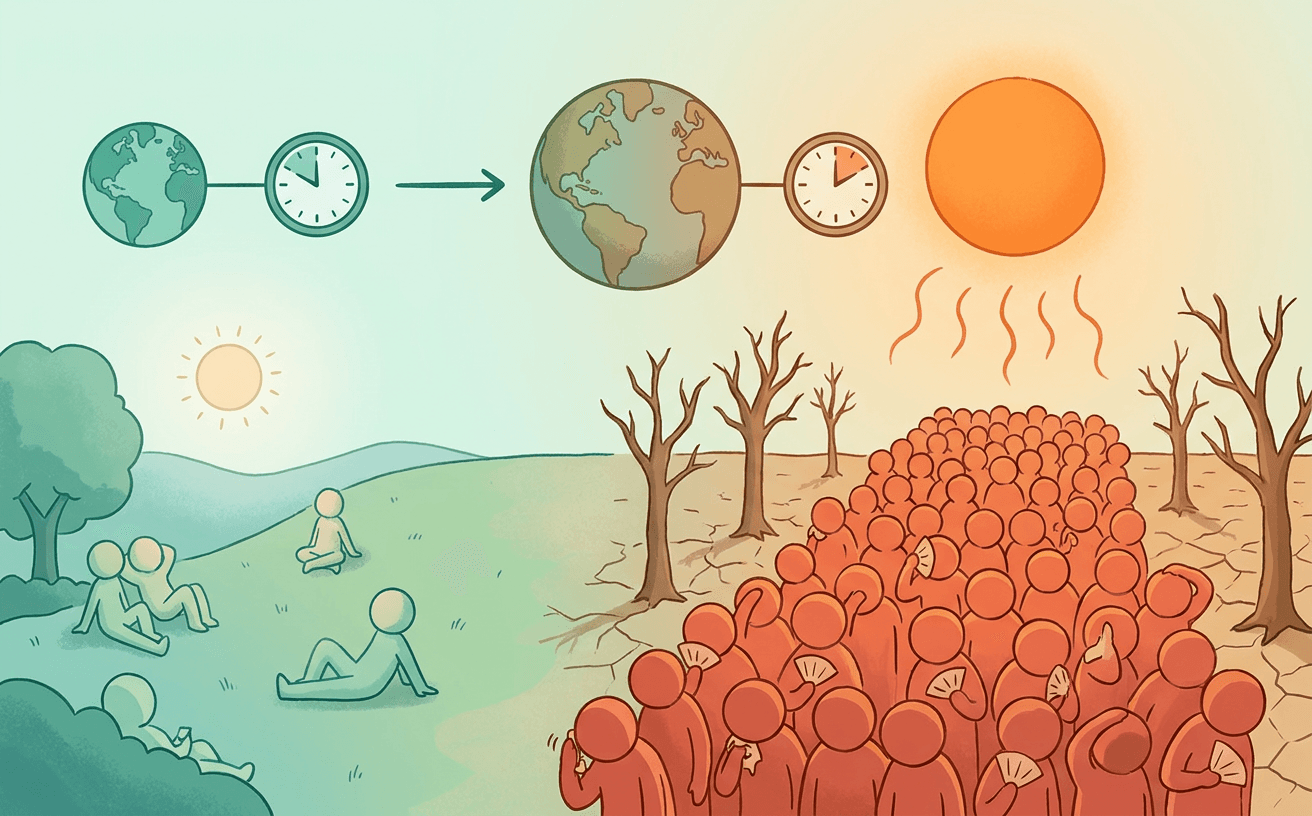
A recent study published in Nature Climate Change reveals that extreme heat stress is increasing globally in frequency, severity, and duration. Compared to the 1970s, an additional one billion people now experience at least one day of extreme heat stress annually. The study highlights that the world's warmest nights are warming faster than its warmest days, indicating a growing threat to public health and urban resilience.
Exam perspectives
The study underscores the changing spatial and temporal distribution of heat stress. Heat stress is not merely determined by absolute temperature but by a combination of factors, primarily temperature, humidity, wind, and radiation, which dictate the net heat load on the human body. This is quantified using the Universal Thermal Climate Index (UTCI), a metric that models human physiological response. The geographical spread is alarming; subtropical regions (like southern Europe and North Africa) are experiencing up to 50 additional days of strong to extreme heat stress annually. The finding that minimum temperatures (nighttime) are rising faster than maximum temperatures (daytime) points to an enhanced greenhouse effect, preventing nighttime cooling, particularly in urban areas exacerbated by the Urban Heat Island effect. For UPSC Geography (GS1), this necessitates understanding microclimatic changes and the distinction between dry heat and humid heat (often measured by wet-bulb temperature), as humid heat is far more lethal to human physiology.
This data reinforces the anthropogenic nature of contemporary climate change. The rise in extreme heat events is a direct consequence of increased greenhouse gas emissions, fundamentally altering the Earth's energy balance. The study highlights the need for a shift from purely mitigation strategies to robust climate adaptation. The continuous warming trend demands that heat stress metrics be integrated into broader climate risk assessments. The Intergovernmental Panel on Climate Change (IPCC) has repeatedly warned about the increasing frequency of extreme weather events. This article provides granular data supporting those warnings. From a GS3 Environment perspective, this emphasizes the need for 'urban cooling interventions'—such as increasing green cover, utilizing cool roofs, and improving urban ventilation—as essential components of sustainable urban planning and building climate resilience.
The escalating threat of heat stress demands a proactive governance response, shifting heatwaves from a purely environmental issue to a critical public health and disaster management challenge. The National Disaster Management Authority (NDMA) in India plays a vital role here by formulating guidelines for Heat Action Plans (HAPs). However, effective implementation at the state and municipal levels is crucial. The study advocates for early-warning systems and targeted interventions to reduce vulnerability. In India, where a significant portion of the workforce is engaged in outdoor, unorganized sectors (like construction and agriculture), extreme heat poses severe occupational health risks and economic losses due to reduced labor productivity. Governance frameworks must incorporate occupational safety standards regarding heat exposure, potentially linking them to labor laws and welfare schemes. This highlights the intersection of GS2 (Governance/Health) and GS3 (Disaster Management/Economy), demanding holistic policy interventions.
Key references
AI-generated study notes, sourced from The Hindu. Verify facts and figures with standard sources.