
Strait of Hormuz disruption biggest risk to India's growth, inflation outlook: Finance Ministry
Context
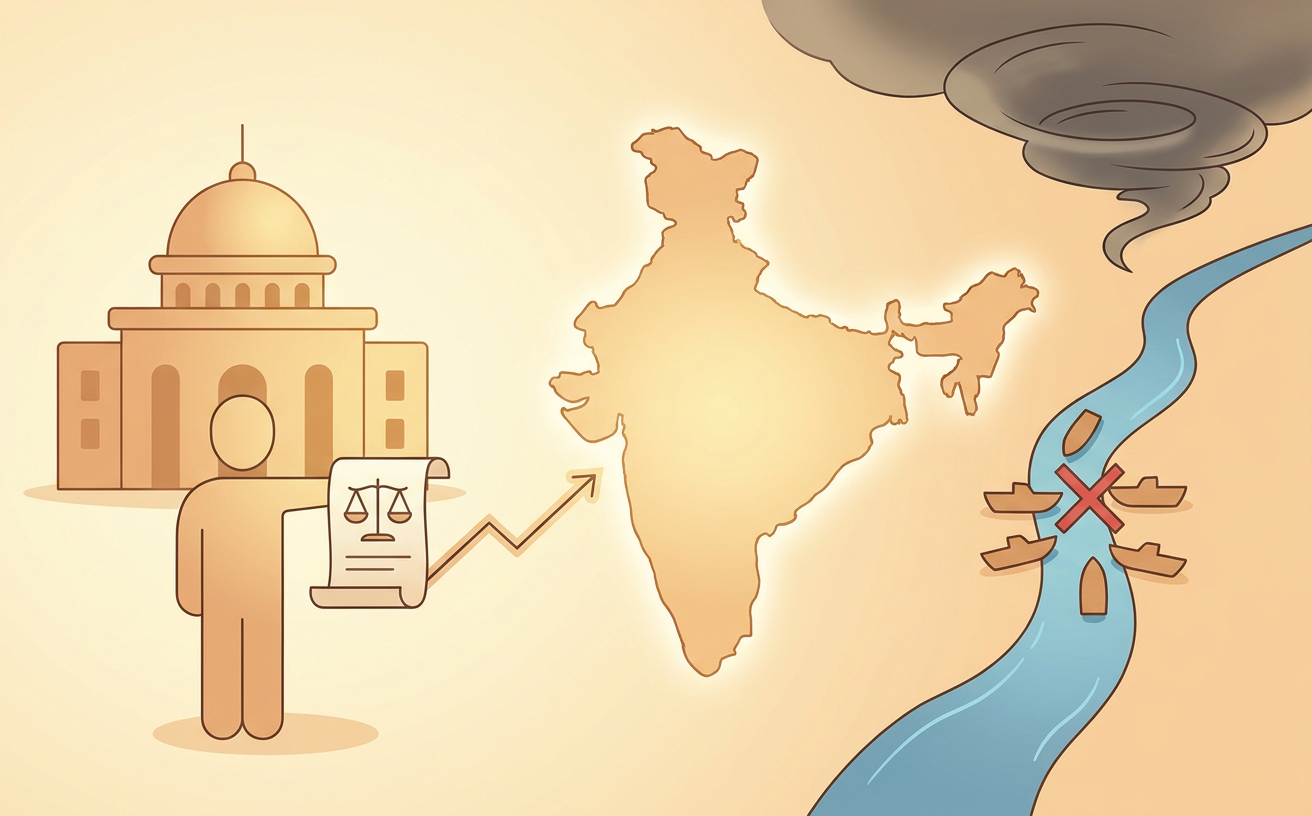
The released its economic review for May, highlighting India's 'cautious resilience' amidst global challenges. It identified disruptions in the as the primary risk to India's external trade and inflation outlook, while also addressing concerns regarding a potential monsoon deficit and the depreciation of the .
Exam perspectives
The Ministry of Finance's review underscores the vulnerability of India's macroeconomic stability to external supply-side shocks. The potential disruption in the Strait of Hormuz, a critical chokepoint for global energy supplies (handling roughly 20% of the world's oil), poses a significant risk of imported inflation. This occurs when the cost of imported raw materials, particularly crude oil, rises, leading to broad-based price increases across the domestic economy. The review also notes the divergence between retail inflation (Consumer Price Index) and wholesale inflation (Wholesale Price Index), suggesting that upstream cost pressures (like higher energy costs) are building and could soon be passed on to consumers. Furthermore, a deficient southwest monsoon could exacerbate these pressures by triggering food inflation, creating a dual challenge for policymakers. UPSC candidates should understand the concept of cost-push inflation and how the Reserve Bank of India must balance containing inflation with supporting growth, often referred to as the growth-inflation trade-off.
The strategic importance of the Strait of Hormuz cannot be overstated. It is a narrow waterway connecting the Persian Gulf to the Gulf of Oman and the Arabian Sea, bordered by Iran and Oman. Its significance lies in its role as a vital conduit for crude oil exports from the Middle East to global markets, notably Asia. Any prolonged closure or disruption, stemming from geopolitical tensions like the current Iran-US/Israel dynamics, directly threatens India's energy security, given India's high dependence on imported crude oil (over 80%). This highlights the necessity for India to diversify its energy sources, invest in strategic petroleum reserves, and accelerate its transition to renewable energy to mitigate geopolitical risks. For UPSC Prelims, mapping the Strait of Hormuz, its bordering countries, and other crucial global maritime chokepoints (like the Strait of Malacca, Bab-el-Mandeb, and the Suez Canal) is essential.
The review's analysis of the depreciating Indian Rupee provides a crucial perspective on exchange rate dynamics. Instead of viewing depreciation solely as a sign of weakness, the Ministry of Finance emphasizes the Real Effective Exchange Rate (REER). The REER is a measure of the value of a currency against a weighted average of several foreign currencies divided by a price deflator or index of costs. A REER below 100, as reported, indicates that Indian exports are becoming more competitive in the global market. This currency depreciation is framed as a strategic adjustment in an environment where global capital flows are being redirected towards emerging technologies like AI, primarily in developed markets. The government is relying on a combination of strong macroeconomic fundamentals (like high GDP growth and adequate Foreign Exchange Reserves) and targeted policy interventions to cushion against these external shocks. These interventions include schemes like the Emergency Credit Line Guarantee Scheme and Production Linked Incentive (PLI) schemes, designed to boost domestic manufacturing and exports, thereby structurally improving India's balance of payments over the long term.
Key references
AI-generated study notes, sourced from Economic Times. Verify facts and figures with standard sources.