
The Nobel for IceCube and the search for neutrinos from outer space | Explained
Context
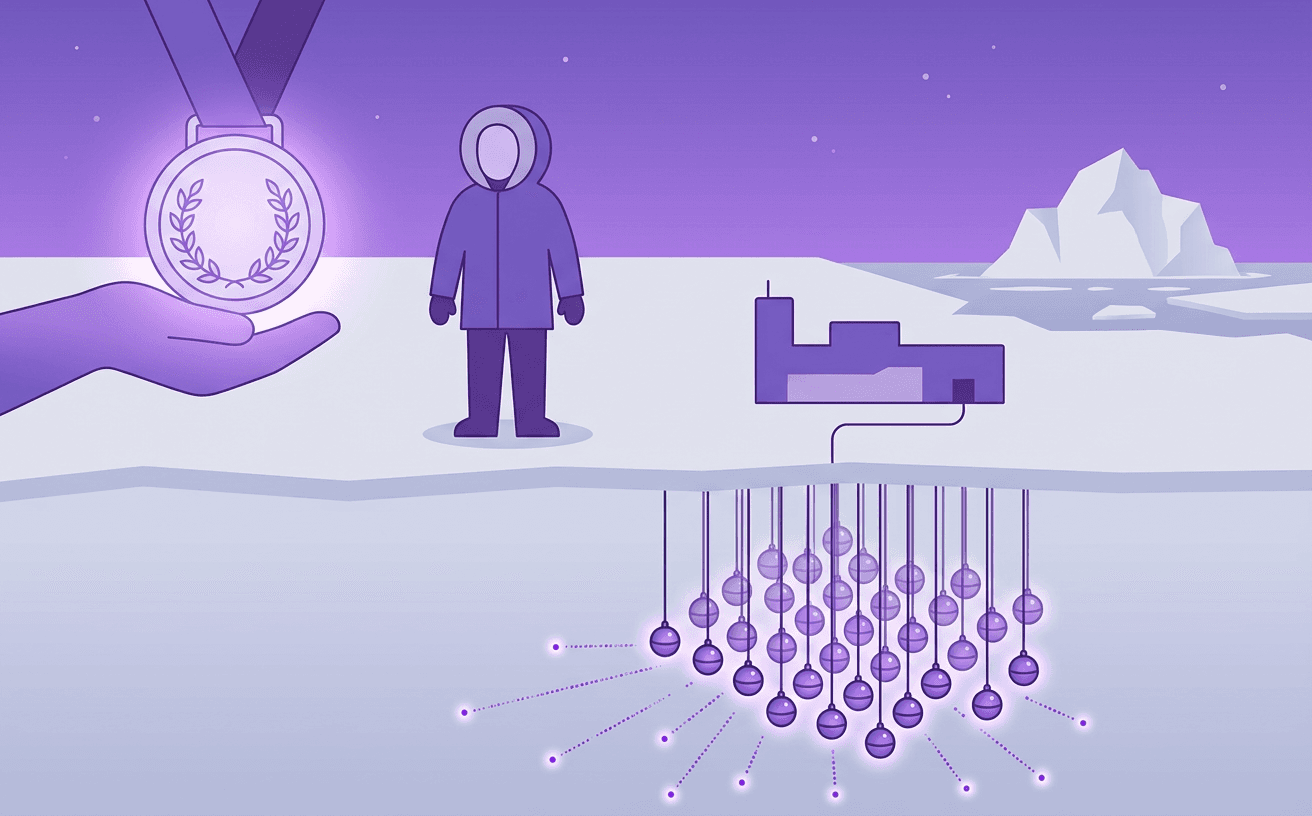
The 2026 Nobel Prize in Physics has been awarded to U.S. physicist Francis Halzen for his pivotal role in developing the in Antarctica. This unique observatory, consisting of thousands of sensors buried deep in the Antarctic ice, detects high-energy neutrinos originating from distant cosmic events, thereby opening a new frontier in multi-messenger astronomy.
Exam perspectives
This development is crucial for the UPSC syllabus regarding 'Awareness in the fields of IT, Space, Computers, robotics, nano-technology, bio-technology'. Neutrinos are subatomic particles that are exceptionally abundant in the universe, produced by nuclear reactions such as those in the sun, exploding stars, or near black holes. Unlike cosmic rays (mostly protons or nuclei) which are charged and get deflected by magnetic fields, neutrinos have no electric charge and minuscule mass. This allows them to travel in straight lines across the cosmos without being absorbed or deflected, making them pristine messengers of distant, high-energy astrophysical phenomena. The challenge lies in their negligible interaction with matter; billions pass through Earth undetected. The IceCube Neutrino Observatory overcomes this by using a cubic kilometer of Antarctic ice as a target medium. When a neutrino rarely interacts with an atom's nucleus in the ice, it creates a cascade of charged particles moving faster than light in that medium, emitting a blue light known as Cherenkov radiation. By detecting this faint light, scientists can deduce the energy and direction of the original neutrino, pointing back to its cosmic source. This represents a significant advancement in Neutrino Astronomy, a field complementing traditional photon-based astronomy.
From a geographical perspective, the choice of location for the IceCube Neutrino Observatory is scientifically significant and relevant to understanding the unique characteristics of the polar regions. The Antarctic ice sheet provides an ideal, optically clear medium necessary for detecting the faint Cherenkov radiation emitted during neutrino interactions. The sheer volume of ice, extending kilometers deep, acts as a colossal, natural detector shield against background cosmic radiation that would otherwise overwhelm the sensors. The extreme environment, however, presents immense logistical challenges, requiring innovative engineering, such as using hot water drills to create boreholes for the sensor strings. This highlights the importance of the Antarctic region not just for climate science, but as a critical platform for fundamental physics research, regulated by international agreements like the Antarctic Treaty System, which dedicates the continent to peace and science. UPSC aspirants should be aware of such unique geographical utility and the infrastructure required to support frontier science in extreme environments.
The success of the IceCube Neutrino Observatory underscores the necessity of robust international collaboration in contemporary 'Big Science'. Funded primarily by the U.S. National Science Foundation but involving hundreds of scientists and engineers from institutions worldwide, IceCube exemplifies how complex, large-scale scientific endeavors exceed the capacity of single nations. This relates to the UPSC syllabus topic on 'Bilateral, regional and global groupings and agreements involving India and/or affecting India's interests', specifically regarding science diplomacy. The sharing of massive datasets globally enables multi-messenger astronomy, where observations from different observatories (e.g., detecting light, gravitational waves via LIGO, and neutrinos) are combined to provide a comprehensive understanding of cosmic events. Such collaborative frameworks are essential for advancing human knowledge and highlight the role of science in fostering international cooperation, a theme frequently explored in the Mains examination.
Key references
AI-generated study notes, sourced from The Hindu. Verify facts and figures with standard sources.