
Warming Himalayas demand a rethink on development
Context
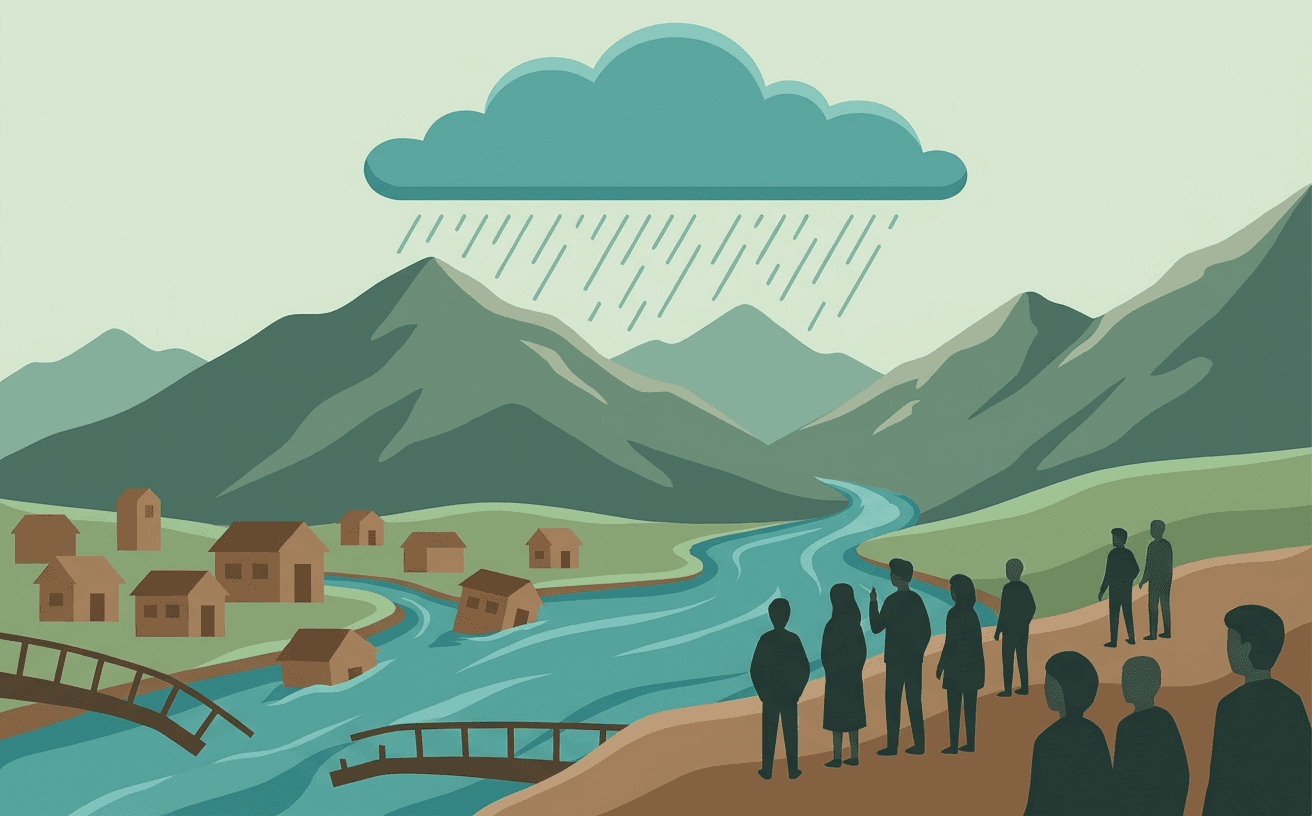
The Indian Himalayan Region (IHR) and the broader Hindu Kush-Karakoram-Himalaya system are facing severe climate-induced disasters, exemplified by the August 2026 Nepal floods. With the region warming at nearly twice the global average, leading to rapid glacier retreat and permafrost thaw, experts are calling for a complete reassessment of development policies, particularly regarding hydropower and infrastructure projects in high-altitude, fragile ecosystems.
Exam perspectives
The article highlights the physical geography of the cryosphere (the frozen water part of the Earth system) in the Himalayas and how climate change is altering it. The warming of the high mountains, noted by the Intergovernmental Panel on Climate Change (IPCC), is causing glaciers to retreat and thin. A critical mechanism explained is the formation of supraglacial lakes (meltwater pools on top of glaciers) and moulins (vertical shafts). These allow water to penetrate to the bedrock, lubricating the glacier and accelerating its movement, while creating pressure that fractures the ice. Furthermore, the thawing of permafrost, which acts as a 'geological cement' holding steep slopes together, leads to instability, rock avalanches, and debris flows. Understanding these mechanisms is crucial for GS Paper 1 questions on physical geography and the impacts of climate change on specific landforms.
From an environmental perspective, the situation in the Himalayas represents a crisis of the 'global natural commons'. The rapid ice-loss, as reported by the International Centre for Integrated Mountain Development (ICIMOD), threatens water security for millions downstream and increases disaster risks. The article underscores the disproportionate impact of climate change; countries like Nepal, which contribute minimally to global greenhouse gas emissions (roughly 0.1%), are suffering severe consequences, raising the issue of climate justice and the need for compensation for loss and damage—key concepts in international climate negotiations under the UNFCCC. The proposed infrastructure projects, such as the Chenab-Beas river-linking project in Himachal Pradesh, must be scrutinized against their potential to exacerbate environmental degradation in this already fragile ecosystem.
The governance challenge lies in balancing development needs with environmental sustainability and disaster mitigation. The article strongly advocates for a shift towards climate-resilient development and hazard-averse planning in the IHR. Crucially, it calls for a rethink of hydropower policy, referencing recommendations from the Avay Shukla Committee and the Ravi Chopra Committee to restrict major projects above certain elevations (e.g., 2,200 metres). Effective governance requires implementing early warning systems using satellite surveillance and real-time sensor networks along glacier-fed rivers. Furthermore, flood zoning policies must be adapted to the specific topography, accounting for valley slopes to determine safe infrastructure placement. A moratorium on development projects pending rigorous environmental impact reassessments is suggested, highlighting the need for robust Environmental Impact Assessments (EIA) in ecologically sensitive zones.
Key references
AI-generated study notes, sourced from The Hindu. Verify facts and figures with standard sources.