
Why are States divided over the mining amendment?
Context
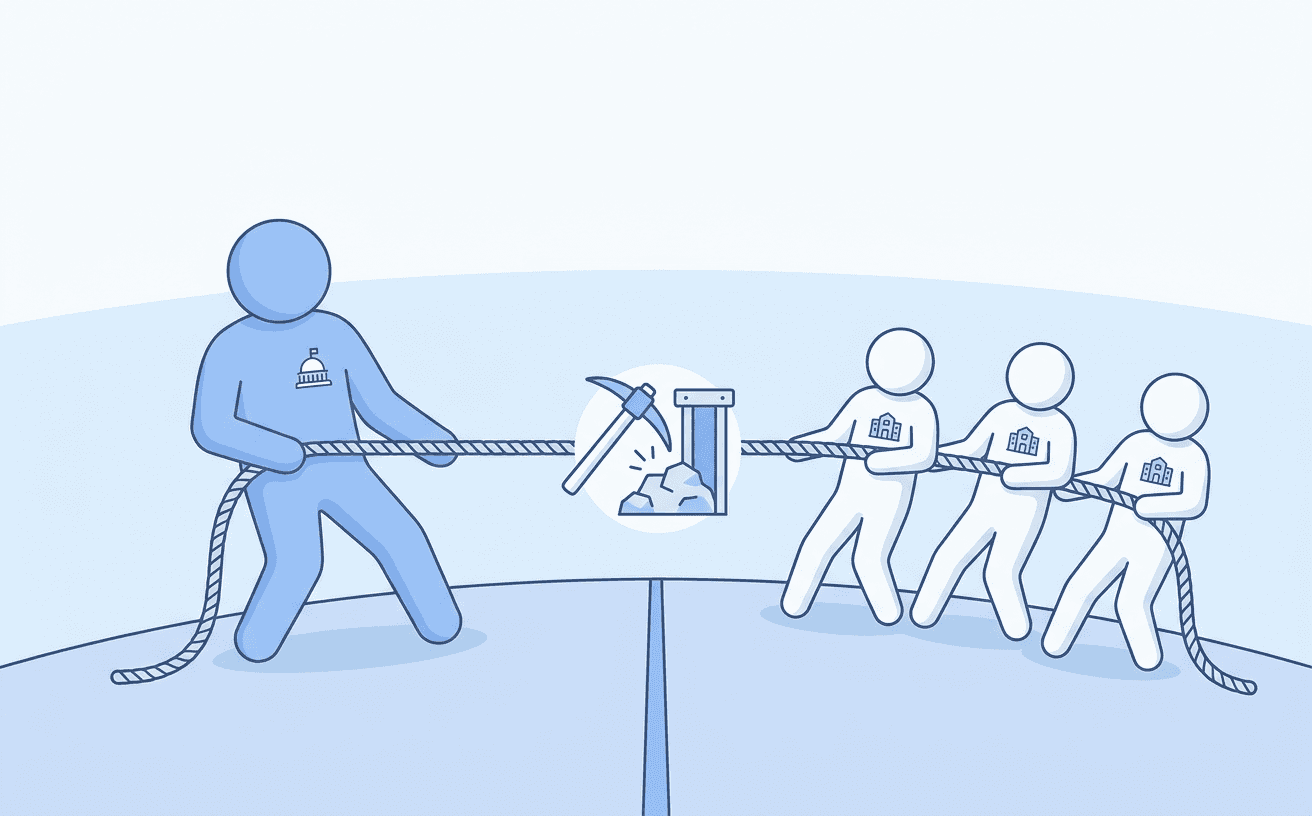
The Centre and States are at odds over the recently amended Mines and Minerals (Development and Regulation) Act. The amendment expands the Centre's regulatory power over mining to include mineral-bearing lands, barring States from imposing fresh taxes and cancelling unrecovered past dues. This conflicts with a recent Supreme Court judgment upholding the States' power to tax mineral rights and mineral-bearing land, sparking a debate on fiscal federalism and the financial autonomy of mineral-rich States.
Exam perspectives
The controversy highlights the complex interplay of legislative powers under the Seventh Schedule of the Indian Constitution. Entry 23 of the State List grants States the power to regulate mines and minerals, but this is explicitly made subject to Entry 54 of the Union List, which allows Parliament to regulate mining in the "public interest". This creates an inherent tension, often leading to conflicts over the extent of the Centre's overarching authority. The recent amendment is seen by many States as an overreach, utilizing the Centre's regulatory authority to restrict the States' taxation powers granted under Entries 49 and 50 of the State List (taxes on lands and buildings, and taxes on mineral rights). This sets up a constitutional clash, particularly given the 2024 Supreme Court ruling in Mineral Area Development Authority v. Steel Authority of India Ltd., which affirmed the States' competence to levy such taxes. This issue exemplifies the evolving and often contentious nature of federalism in India, where the balance of power frequently requires judicial interpretation. UPSC questions often focus on the distribution of legislative powers and the implications of central legislation encroaching on State domains.
The dispute centers on fiscal federalism and the financial autonomy of States. Mineral revenue is a crucial component of non-tax revenue for resource-rich States like Odisha and Jharkhand, sometimes constituting up to 80% of these receipts. The amendment's provision to cancel uncollected past dues significantly impacts their fiscal capacity and ability to fund social security schemes. The Centre's rationale—that disparate state taxes increase domestic mineral costs, driving industries toward imports and burdening the exchequer—highlights the challenge of balancing uniform national economic policies with state-level revenue generation. India's fiscal architecture is often described as asymmetric federalism, where the Centre holds broader taxation powers while States bear significant expenditure responsibilities. This structural imbalance makes States heavily reliant on central transfers (via the Finance Commission) and borrowing approvals, limiting their autonomy. The mining tax issue is a prime example of how central policies can directly constrain the fiscal space available to States, a key theme for GS Paper 3 regarding government budgeting and resource mobilization.
The political response to the amendment underscores how political alignment influences federal dynamics. The discontent is not uniformly distributed based solely on fiscal reliance; it is mediated by the political geography of the States. For instance, while non-NDA governed States like Karnataka, Telangana, and Kerala are planning to challenge the law in the Supreme Court, NDA-aligned States with significant mineral revenues, such as Madhya Pradesh and Rajasthan, have not raised similar objections. This indicates that while the erosion of fiscal space creates a material stake, translating that into an organized federal challenge often depends on political factors. Furthermore, Kerala's concern that the Centre's expanded power over mineral-bearing lands could lead to greater central control over sensitive areas like coastal and forest regions highlights the broader governance implications of centralizing regulatory authority. This case illustrates the practical challenges of cooperative federalism, where legislative and fiscal disputes require continuous negotiation and resolution mechanisms between the Union and the States.
Key references
AI-generated study notes, sourced from The Hindu. Verify facts and figures with standard sources.