
Commerce Ministry identifying AI-proof professions, sectors where India can take global lead: Goyal
Context
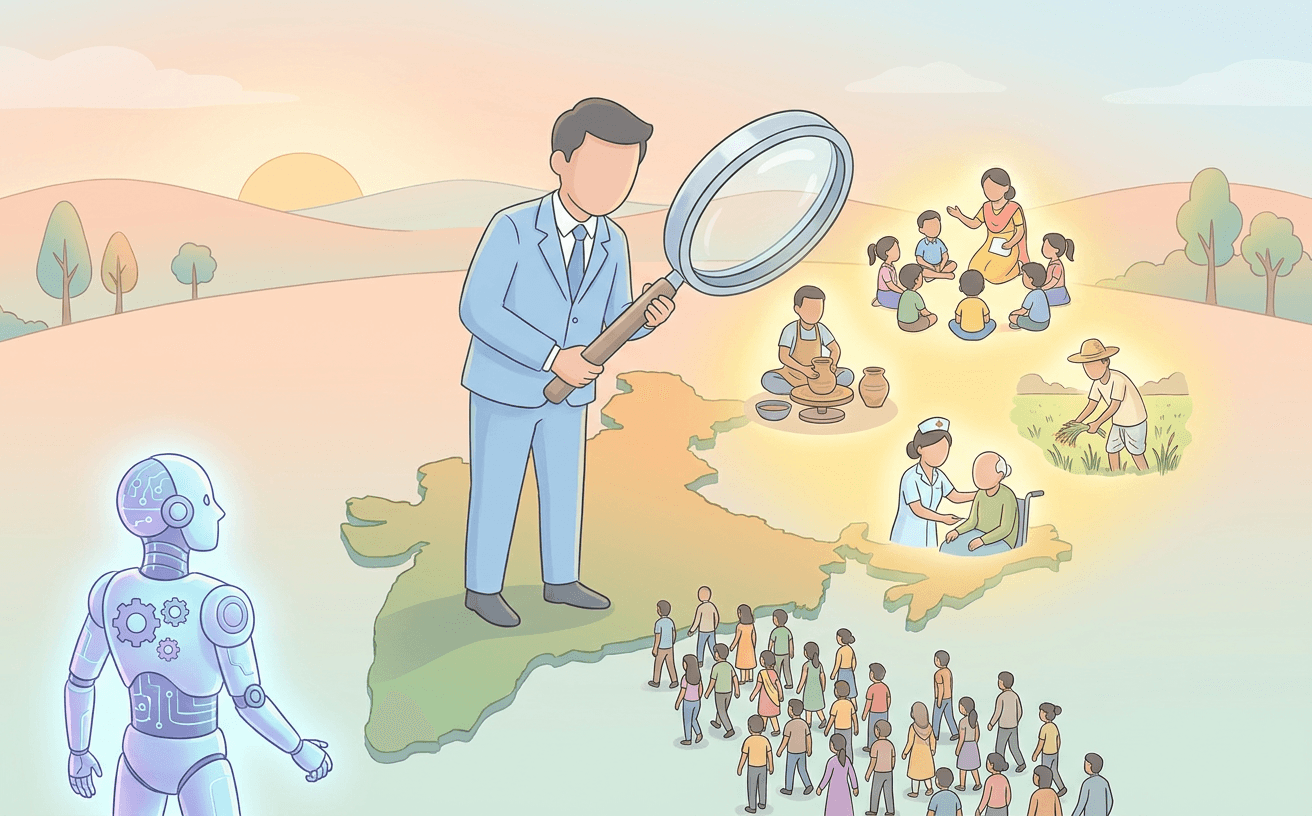
The is actively identifying 'AI-proof' professions and sectors where India can leverage its traditional strengths and demographic dividend to become a global leader. Union Minister , speaking in Germany, emphasized a strategy of utilizing Artificial Intelligence (AI) to enhance efficiency without displacing the human workforce, particularly in sectors like handicrafts, handlooms, and tourism. The government is also focusing on creating an enabling ecosystem to reverse the brain drain and attract Indian researchers and scientists back to the country.
Exam perspectives
The transition towards an AI-driven economy presents a critical challenge of technological unemployment, where automation disrupts traditional job markets. The government's proactive identification of 'AI-proof' sectors—such as handicrafts, handlooms, and tourism—is a strategic move to safeguard livelihoods and capitalize on India's comparative advantage in human-centric, creative industries. This approach aligns with the need to generate employment for a large youthful population, ensuring a demographic dividend rather than a demographic disaster. By focusing on sectors where AI augments human efficiency (a concept known as complementary AI or human-in-the-loop AI) rather than substituting it, India aims to balance technological advancement with inclusive economic growth. The Ministry of Commerce and Industry is signaling a policy direction that prioritizes sustainable job creation alongside technological adoption. UPSC aspirants should analyze the economic implications of AI disruption, evaluating the potential of traditional sectors to absorb displaced labor and the structural reforms needed to upskill the workforce for the jobs of the future.
The discourse around AI is shifting from pure disruption to strategic integration. The government's focus is on deploying AI to enhance productivity in specific sectors without widespread job displacement. This requires a nuanced understanding of AI's capabilities and limitations; while AI excels at repetitive cognitive tasks, it struggles with tasks requiring high levels of emotional intelligence, creativity, and complex physical dexterity—traits inherent in professions like culinary arts and handicrafts. Furthermore, the push to attract Indian researchers and scientists from abroad addresses the long-standing issue of brain drain. Minister Goyal emphasized that creating a robust innovation ecosystem involves more than financial incentives; it requires strong industry-academia partnerships, adequate funding for research and development (R&D), and supportive infrastructure. This aligns with national goals to enhance Gross Expenditure on Research and Development (GERD) and foster indigenous technological capabilities. UPSC questions may explore the role of the diaspora in technology transfer, the ethical dimensions of AI deployment, and the necessary policy frameworks to foster a conducive R&D environment in India.
The initiative to identify and promote AI-proof sectors reflects a proactive governance model addressing the socio-economic impacts of emerging technologies. This requires a multi-faceted approach involving collaboration between the government, private sector, academia, and civil society—a model often referred to as collaborative governance or networked governance. The government's role transitions from a mere regulator to an enabler, providing necessary support systems (infrastructure, skill development, market access) without heavily relying on direct subsidies or incentives for every activity. This approach aims to build systemic resilience against technological shocks. Moreover, the emphasis on ensuring a 'better life' for 1.4 billion people underscores a commitment to inclusive development and the welfare state principles enshrined in the Directive Principles of State Policy (DPSP). UPSC candidates should consider the governance challenges in anticipating technological trends, designing agile policies that adapt to rapid innovation, and managing the transition for vulnerable workforces.
Key references
AI-generated study notes, sourced from The Hindu. Verify facts and figures with standard sources.