
Cracker conundrum: On need for strict enforcement of cracker ban
Context
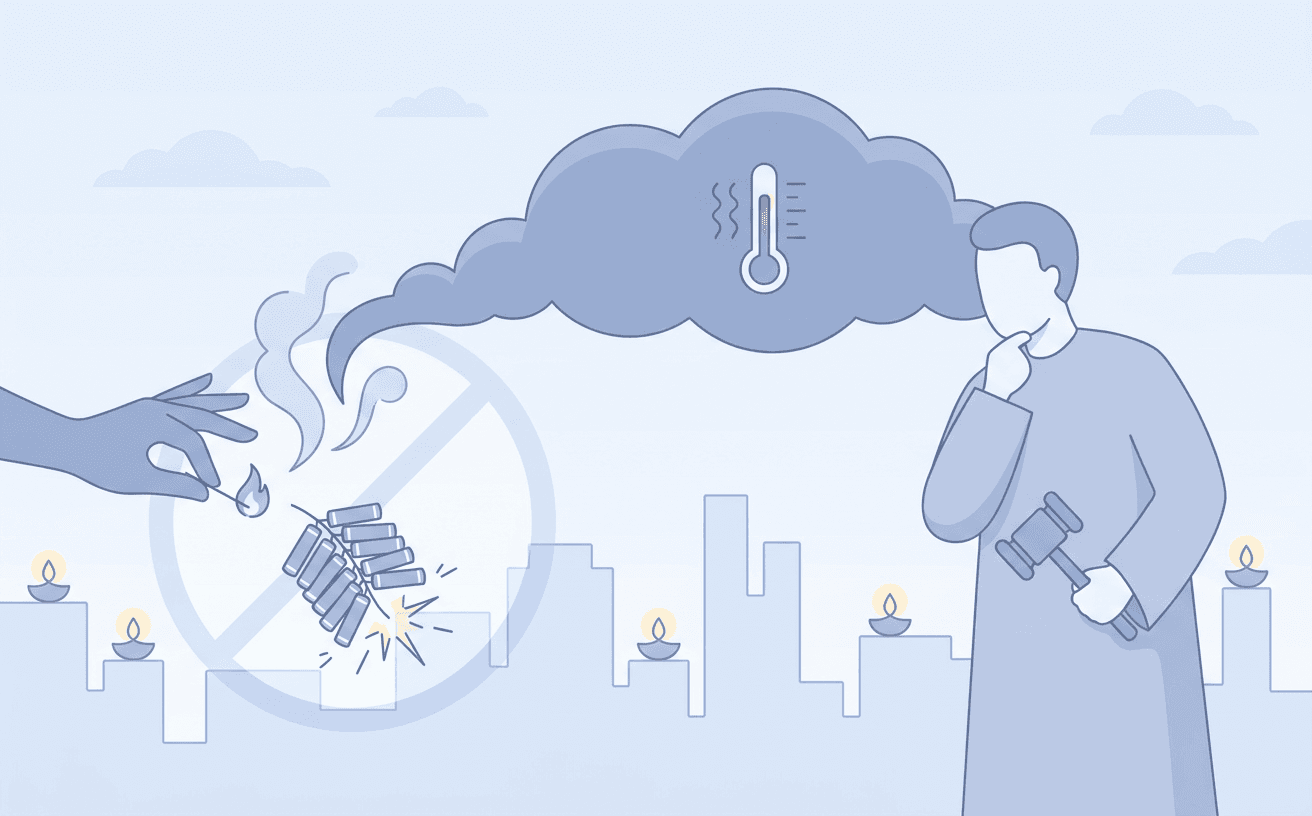
The editorial critically examines the Supreme Court's approach to the ban on firecrackers during Deepavali, noting the recurring pattern of 'severe' levels following the festival despite the Court's temporary relaxations. It highlights the difficulty in isolating the exact share of pollution caused by firecrackers amidst other meteorological and emission factors, while criticizing the efficacy of 'green crackers' and the lack of stringent enforcement.
Exam perspectives
The recurring issue of severe post-Deepavali pollution highlights the complex interplay of meteorological factors and anthropogenic emissions. During this period, the National Capital Region (NCR) experiences slackening winds and post-monsoon atmospheric dryness, which leads to the trapping of particulate matter from various sources like vehicle emissions, industrial activity, construction dust, and stubble burning. Firecrackers, even the CSIR-NEERI developed 'green crackers', add an acute, concentrated load of particulate matter (PM2.5 and PM10) and toxic gases (like sulfur dioxide and nitrogen dioxide) to an already saturated atmosphere. The editorial points out a crucial flaw in relying on 'green crackers': while they may reduce emissions by 30%-45% under laboratory conditions, this percentage reduction is insufficient given the massive baseline volume of emissions on the festival night, leading to an overall deterioration of the Air Quality Index (AQI). This scenario exemplifies the challenges of managing seasonal pollution spikes where cumulative effects overwhelm mitigation efforts that address only a fraction of the total problem.
The debate over firecrackers presents a classic constitutional tension between the right to religion under Article 25 and the right to life, which includes the right to a clean environment, under Article 21. The editorial argues that the Supreme Court pays only 'lip service' to the principle that religious customs cannot override considerations of health and life. This touches upon the concept of essential religious practices; the Court has previously held that bursting firecrackers is not an essential part of religious practice and therefore does not enjoy absolute protection under Article 25. However, the Court's demand for 'quantitative evidence' linking cracker emissions to specific health outcomes creates an unreasonably high evidentiary burden, as isolating the causative impact of one variable in a complex pollution matrix is scientifically challenging. The judiciary's struggle balancing religious sentiments, livelihood concerns of manufacturers, and environmental imperatives often results in ad-hoc, temporary orders rather than a definitive, long-term policy framework.
The enforcement of the firecracker ban illustrates a significant failure in administrative capacity and cooperative federalism. The Supreme Court's orders, while well-intentioned, often stumble at the implementation stage. The editorial notes the 'immense implementation challenges in policing cracker sales.' A complete ban is difficult to enforce due to the porous nature of state borders and the proliferation of illegal manufacturing and supply chains. This highlights the gap between judicial pronouncements and executive action on the ground. The suggestion for a 'time-bound policy' on the manufacture, sale, and use of crackers underscores the need for a comprehensive regulatory framework rather than reactive, last-minute judicial interventions. Effective governance requires proactive policy-making involving the Ministry of Environment, Forest and Climate Change, state pollution control boards, and local enforcement agencies to manage the supply side (manufacturing) and demand side (sales and usage) well before the festival season begins.
Key references
AI-generated study notes, sourced from The Hindu. Verify facts and figures with standard sources.