
Delhi’s rural outskirts are more polluted than the megacity — and crop burning is not the culprit
Context
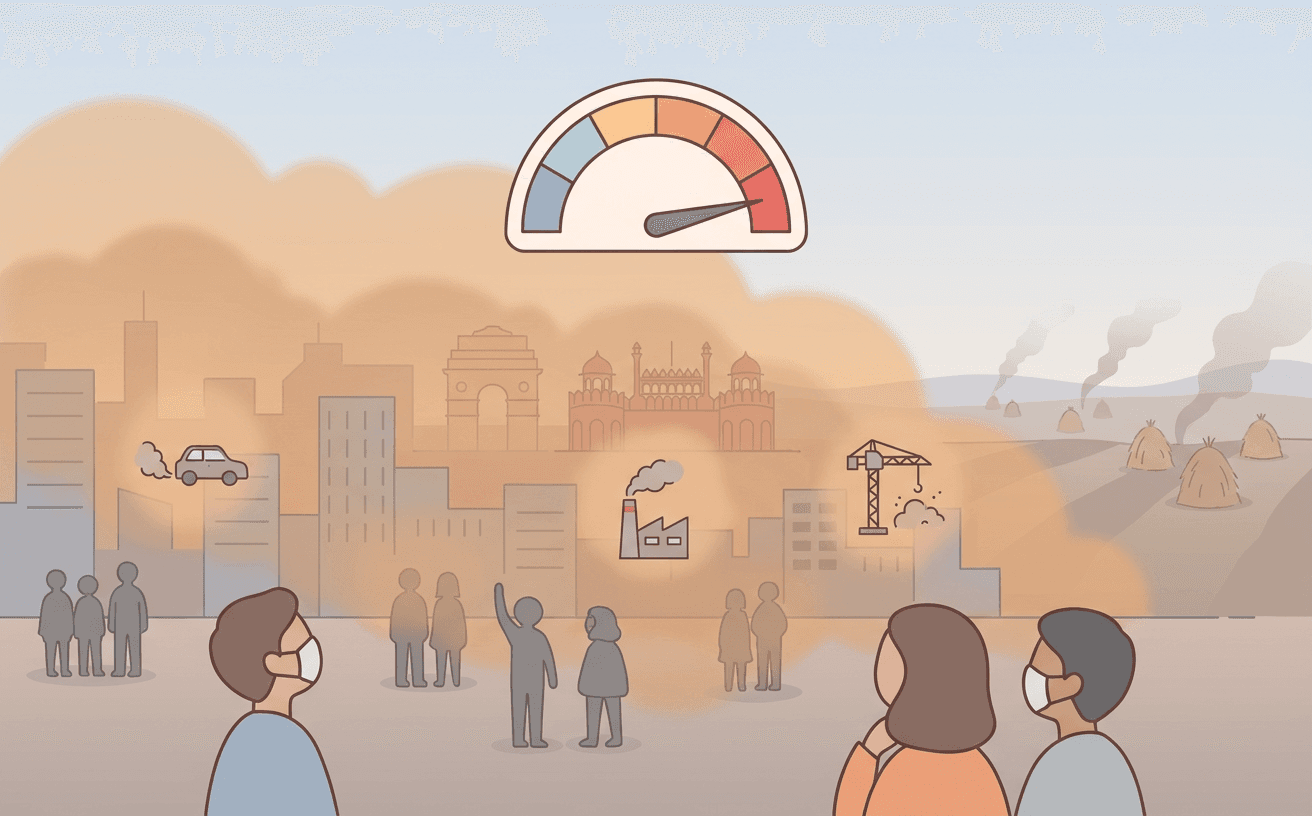
Delhi recently recorded the worst air quality globally, reaching a 'hazardous' Air Quality Index (AQI) of 334. While in neighbouring states is often blamed, the data highlights that rural outskirts are experiencing worse pollution than the megacity itself, driven by vehicular emissions, construction dust, and local factors.
Exam perspectives
The persistent winter smog in Delhi is a classic example of particulate pollution, primarily driven by PM2.5 (particulate matter smaller than 2.5 micrometers). These fine particles can bypass the respiratory system's defenses and enter the bloodstream, causing severe health issues. The situation is exacerbated by a phenomenon known as temperature inversion during winters, where a layer of cold air traps pollutants close to the ground, preventing dispersion. The article challenges the dominant narrative that Stubble Burning in Punjab and Haryana is the sole culprit, highlighting the significant contribution of local sources like vehicular emissions and construction dust. The System of Air Quality and Weather Forecasting And Research (SAFAR) under the Ministry of Earth Sciences provides crucial data for understanding source apportionment. UPSC often asks about the effectiveness of measures like the Graded Response Action Plan (GRAP) and the role of the Commission for Air Quality Management (CAQM) in tackling this recurring crisis.
Delhi's geographical location acts as a major disadvantage in managing air quality. It is a landlocked city situated in the fertile Indo-Gangetic Plain, which acts as a vast basin that traps pollutants emitted from various sources across the region. During winter, the north-westerly winds bring smoke from agricultural fires, while the lack of strong winds locally prevents the dispersal of accumulated pollutants. This highlights the concept of an airshed, a geographical area where local topography and meteorology limit the dispersion of pollutants. The finding that rural outskirts are more polluted than the city center challenges traditional understanding and points towards a complex interaction of urban sprawl, localized industrial activities, and possibly the 'spillover' effect of urban pollution being pushed outward. This necessitates a regional approach to air quality management rather than focusing solely on the city limits.
The chronic air pollution crisis in the National Capital Region (NCR) exposes critical gaps in environmental governance. Despite the existence of multiple bodies like the Central Pollution Control Board (CPCB), the state pollution control boards, and the newly formed Commission for Air Quality Management (CAQM), enforcement remains weak. The issue underscores the challenge of cooperative federalism, as tackling the crisis requires seamless coordination between Delhi and its neighboring states (Punjab, Haryana, Uttar Pradesh, and Rajasthan). The reliance on emergency measures like the Graded Response Action Plan (GRAP), which involves restrictions on construction and vehicular movement, highlights a reactive rather than a proactive approach. Long-term solutions demand addressing the root causes: transitioning to cleaner fuels, improving public transport infrastructure, strictly enforcing construction dust management norms, and providing viable alternatives to farmers to prevent stubble burning. The right to breathe clean air is implicit in the Right to Life under Article 21 of the Constitution, making it a fundamental governance imperative.
Key references
AI-generated study notes, sourced from The Hindu. Verify facts and figures with standard sources.