
How governmentality exacerbates the problem of farmers’ stubble burning
Context
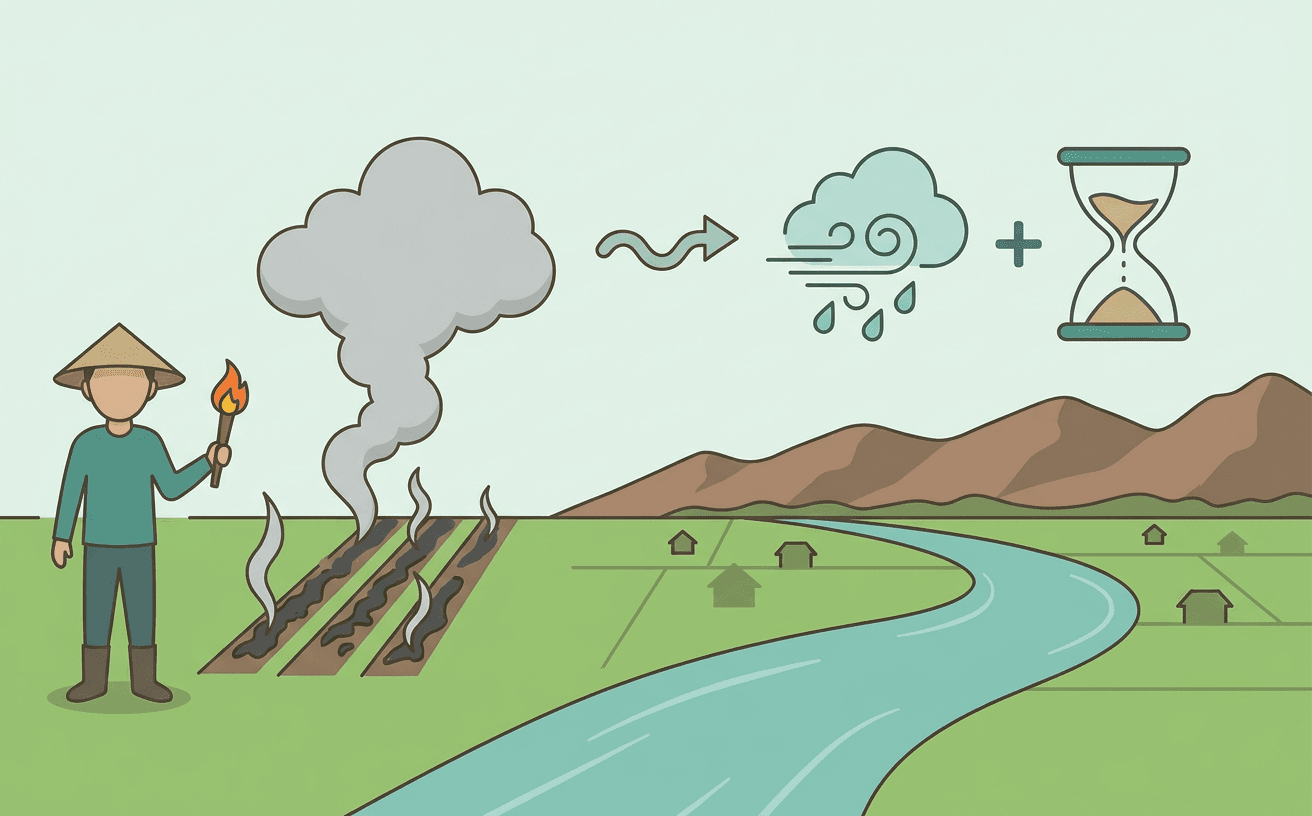
A recent academic study explores the issue of stubble burning in the Indo-Gangetic Plain, linking the persistent pollution problem to a combination of meteorological factors and the concept of 'governmentality' within a neoliberal framework. The article highlights how atmospheric inversion layers trap pollutants from various sources, which are significantly worsened by the burning of rice chaff by farmers in states like Punjab and Haryana during October and November as they prepare fields for the Rabi crop.
Exam perspectives
The article provides an excellent practical example of atmospheric inversion, a core concept in climatology. Under normal conditions, temperature decreases with altitude, allowing warm, polluted surface air to rise and disperse. However, during the winter months in the Indo-Gangetic Plain, an inversion layer forms. This is a meteorological phenomenon where a layer of warm air traps cooler air near the surface, acting like a lid. This prevents the vertical mixing of air, trapping pollutants—including particulate matter from stubble burning, vehicular emissions, and construction dust—close to the ground. The cessation of the southwest monsoon winds further reduces horizontal dispersion. For UPSC, understanding how these geographical factors interact with anthropogenic activities is crucial, as questions often require linking physical geography concepts to contemporary environmental issues like the Delhi smog.
Stubble burning is a significant contributor to the deterioration of the Air Quality Index (AQI) in North India. The burning of paddy crop residue releases large amounts of harmful pollutants, including Particulate Matter (PM2.5 and PM10), carbon monoxide, and volatile organic compounds. This severe air pollution is a direct threat to public health, violating the right to a pollution-free environment, which the Supreme Court has interpreted as an integral part of the Right to Life under Article 21 of the Constitution. The issue necessitates intervention by bodies like the Commission for Air Quality Management (CAQM) and the National Green Tribunal. Aspirants should analyze the environmental impact not just in terms of air quality, but also the loss of soil nutrients and beneficial soil microorganisms caused by the burning process, and evaluate the effectiveness of mitigation strategies like the promotion of the Happy Seeder machine and in-situ crop residue management.
The article touches upon the economic compulsions driving stubble burning. Farmers resort to burning the rice chaff because it is the most cost-effective and time-efficient method to clear fields before sowing the Rabi crop, primarily wheat. The short window between the Kharif harvest and Rabi sowing leaves little time for alternative, more labor-intensive residue management. This highlights a market failure where the environmental costs (negative externalities) of burning are not borne by the farmers, while the costs of adopting sustainable practices are. The reference to 'governmentality' and 'neoliberal India' suggests a critique of agricultural policies that focus heavily on yield (often linked to the Minimum Support Price regime for paddy) without adequately supporting sustainable transition mechanisms. UPSC Mains questions could ask candidates to evaluate the trade-offs between agricultural productivity, farmer livelihoods, and environmental sustainability, and to propose policy interventions that align economic incentives with ecological conservation.
Key references
AI-generated study notes, sourced from The Hindu. Verify facts and figures with standard sources.