
Indonesia’s wildfires scorch 1.9 million hectares
Context
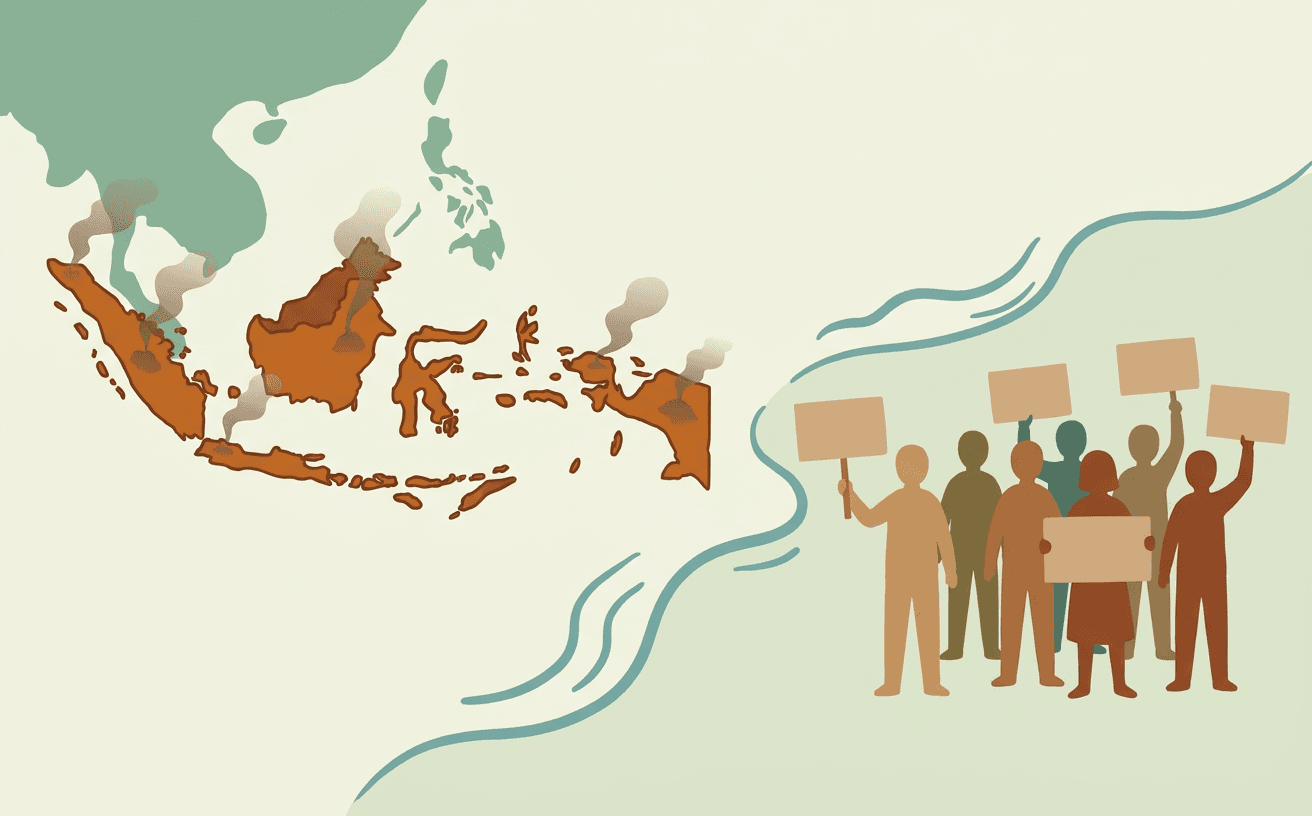
Indonesia is experiencing a severe wildfire crisis, with over 1.9 million hectares burned between January and September 2026, leading to massive public protests against the government. The fires, driven by a combination of slash-and-burn agriculture, peatland drainage, and extreme weather phenomena like **** and a positive ****, are causing a transboundary haze crisis affecting neighboring countries and significantly impacting public health.
Exam perspectives
The Indonesian wildfires present a classic case study of how localized human activities are exacerbated by large-scale ocean-atmosphere phenomena. The crisis is significantly worsened by El Niño, a climate pattern characterized by the unusual warming of surface waters in the eastern tropical Pacific Ocean, which typically brings drought to Southeast Asia and Australia. Furthermore, the Indonesian Meteorology, Climatology, and Geophysical Agency highlights the role of the Indian Ocean Dipole (IOD), specifically a positive phase where the western Indian Ocean is warmer than the eastern part, further reducing rainfall over Indonesia. For UPSC Prelims and GS-1 (Geography), understanding the mechanics of El Niño and the IOD, and their specific impacts on regional precipitation patterns, is crucial. Questions frequently test the relationship between these phenomena and the Indian Monsoon, but their role in exacerbating forest fires in Southeast Asia or Australia is an equally important application.
The core environmental issue highlighted in this crisis is the vulnerability and mismanagement of peatlands. Peatlands are a type of wetland where waterlogged conditions prevent plant material from fully decomposing, resulting in the accumulation of peat—a highly carbon-rich soil. When these areas are drained for commercial agriculture (like palm oil plantations), the peat dries out and becomes highly flammable. Once ignited, peat fires are exceptionally difficult to extinguish because they can smoulder underground for weeks, releasing massive amounts of carbon dioxide and toxic particulate matter (PM2.5). This practice, often linked to 'slash and burn' agriculture, not only destroys biodiversity but also turns vital carbon sinks into massive carbon emitters, accelerating global climate change. For GS-3 (Environment), candidates should be prepared to discuss the ecological significance of peatlands, the specific challenges of fighting peat fires, and the long-term climate implications of their destruction.
The crisis demonstrates the complex challenge of environmental governance and the management of transboundary pollution. The haze from Indonesia's fires is not contained within its borders; it severely impacts the air quality and public health in neighboring countries like Malaysia and Singapore. In response to corporate involvement in these fires, Singapore is utilizing its Transboundary Haze Pollution Act, a pioneering piece of extraterritorial legislation designed to penalize entities causing haze pollution in Singapore, regardless of where the fires occur. Furthermore, the ongoing discussions between Indonesia and Singapore to establish a joint task force highlight the necessity for regional cooperation in disaster management and environmental protection. For GS-2 (International Relations) and GS-3 (Disaster Management), this scenario illustrates the limitations of national sovereignty when dealing with environmental crises and the emerging legal and diplomatic frameworks required to address transboundary environmental harm.
Key references
AI-generated study notes, sourced from The Hindu. Verify facts and figures with standard sources.