
Srikakulam farmers own the land but not the manganese Vedanta wants beneath it
Context
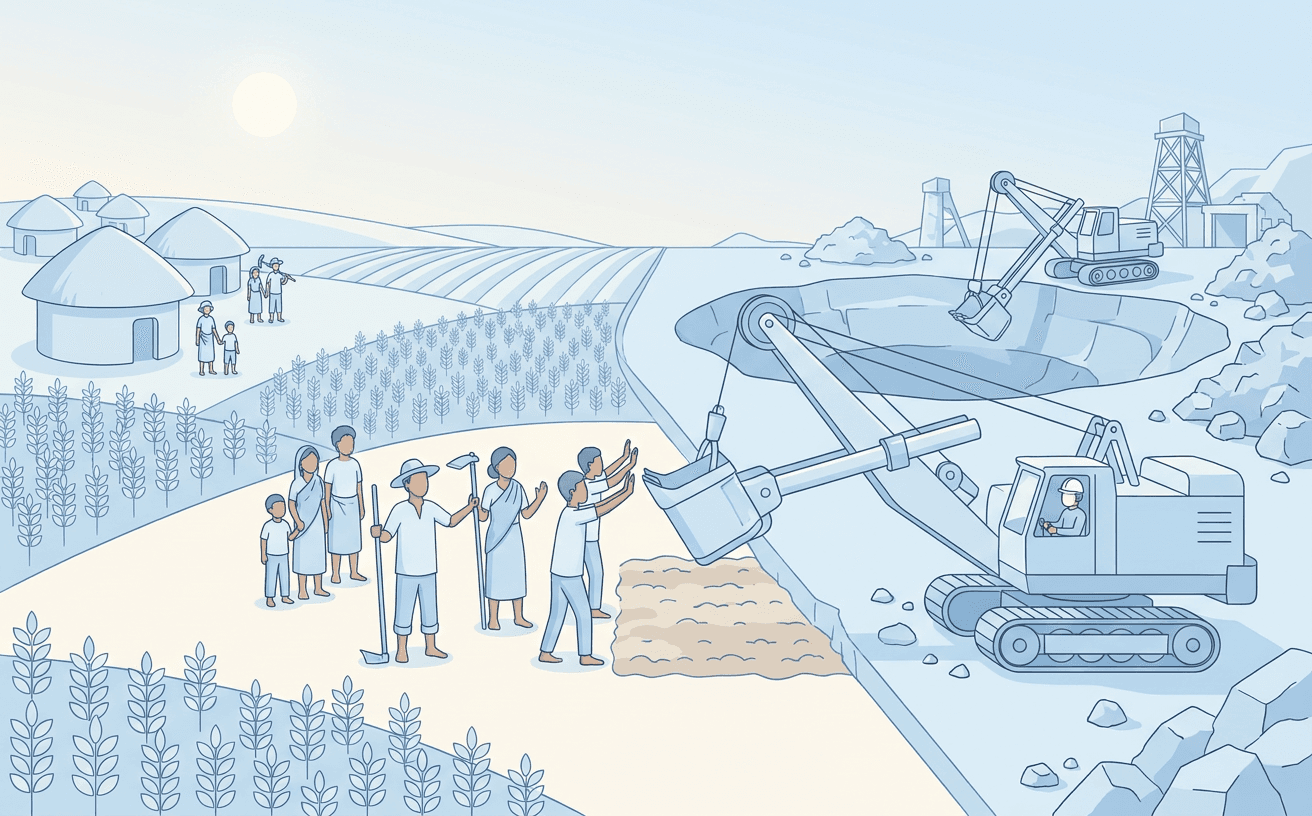
Farmers in Srikakulam, Andhra Pradesh, are protesting a proposed manganese mining project by on land they claim has been cultivated by their families for generations. The state government auctioned the block to Vedanta, leading to a survey by authorized by local officials on land designated as 'government land', highlighting the recurring conflict between resource extraction and traditional land rights.
Exam perspectives
This case highlights the complexities surrounding land ownership and sub-surface rights in India. Generally, under Indian law, while surface rights may belong to the landowner, sub-surface rights (minerals and resources beneath) rest with the State. This principle is rooted in the doctrine of 'Eminent Domain', allowing the state to acquire private land for public purpose under the Right to Fair Compensation and Transparency in Land Acquisition, Rehabilitation and Resettlement Act, 2013. However, conflicts arise when land categorized as 'government land' by the state is traditionally cultivated by local communities who may lack formal titles. The issuance of a No Objection Certificate (NOC) by the Tahsildar for surveys on such land often bypasses crucial consultations with the Gram Sabha, as mandated in scheduled areas under the PESA Act, 1996, though it's unclear if these specific villages fall under the Fifth Schedule. This raises concerns about due process and the protection of livelihood rights against corporate interests.
The auction of the Punnam Manganese Block aligns with the National Mineral Policy, 2019, which aims to boost domestic exploration and reduce import dependency on critical minerals like manganese, essential for steel production. The state government's e-auction process is governed by the Mines and Minerals (Development and Regulation) Act, 1957 (MMDR Act), which was amended to introduce competitive bidding to ensure transparency and maximize state revenue. Vedanta's Letter of Intent (LoI) signifies the initial step towards acquiring a mining lease. However, the economic rationale for resource extraction often clashes with the local agrarian economy. The displacement of farmers and loss of agricultural land highlight the need for a robust rehabilitation and resettlement framework, a persistent challenge in India's industrialization trajectory.
The immediate disruption of farming activities by survey teams underscores the vulnerability of rural communities whose livelihoods are intrinsically tied to the land. The sudden appearance of surveyors, even with official permission, creates anxiety and insecurity among farmers who depend on the land for subsistence. The fact that the survey targeted 'government land' being actively cultivated points to the issue of 'encroachment' versus 'traditional rights'. The Forest Rights Act, 2006 provides a mechanism for recognizing traditional rights on forest land, but similar protections for traditional cultivators on non-forest government land are often weaker. This incident exemplifies the classic 'development vs. displacement' paradigm, emphasizing the necessity of balancing national economic goals with the fundamental rights and livelihoods of marginalized rural populations.
Key references
AI-generated study notes, sourced from The Hindu. Verify facts and figures with standard sources.