
Why Delimitation Bill failed to pass in Parliament in April 2026
Context
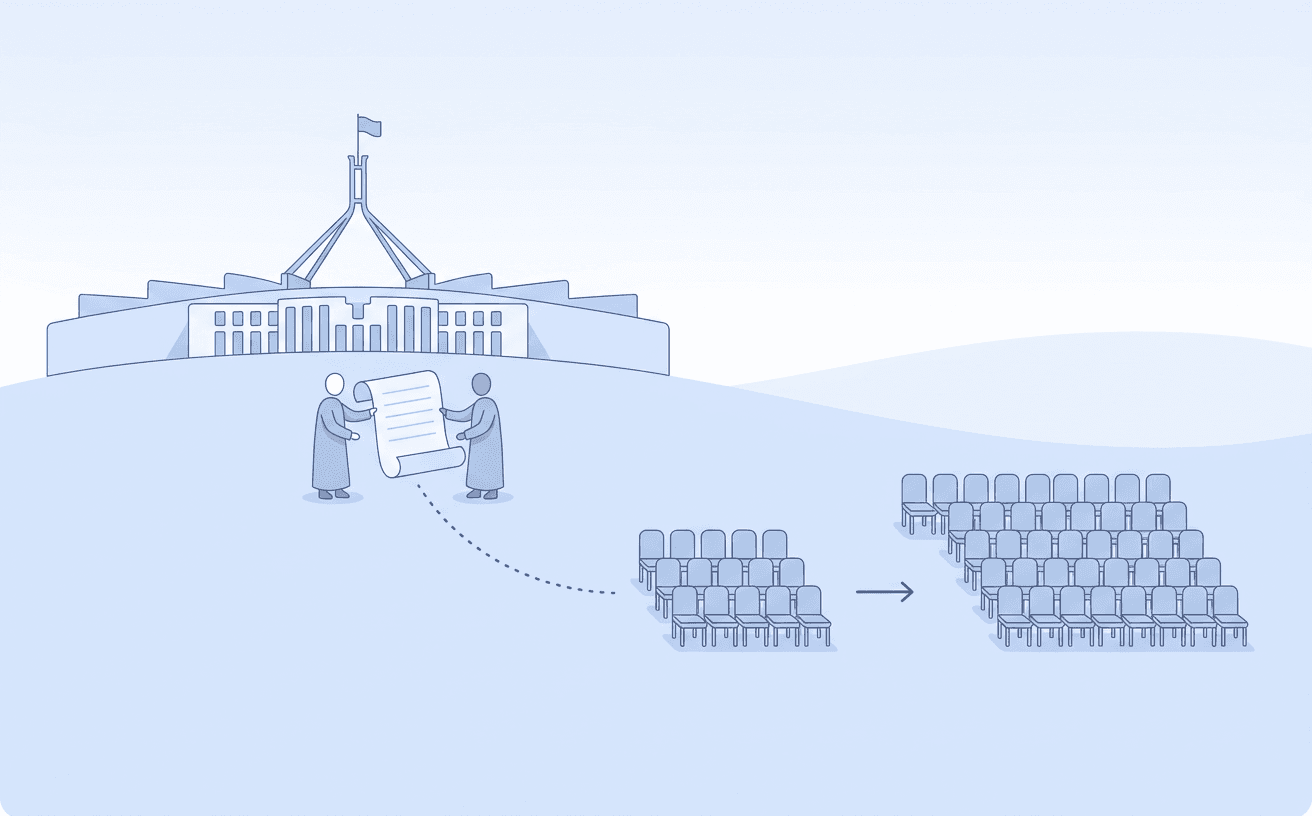
The Union government is planning to reintroduce the Delimitation Bill during a special parliamentary sitting in November 2026. The proposed legislation seeks to increase Lok Sabha seats by 50% (from 543 to 850), extend the freeze on the inter-state distribution of seats based on the for another 25 years, and redraw constituency boundaries within states using data. The previous attempt to pass the in April 2026 failed due to opposition concerns over proportional representation, potential disadvantage to southern states, and the linking of women's reservation to the delimitation exercise.
Exam perspectives
The process of delimitation involves redrawing the boundaries of Lok Sabha and State Assembly constituencies to represent changes in population. This is mandated by Article 82 of the Constitution, which requires a readjustment of seats after every census. The exercise is carried out by an independent, high-powered Delimitation Commission, whose orders have the force of law and cannot be challenged in court. The proposed Constitution (131st Amendment) Bill failed to secure the required special majority (two-thirds of members present and voting, plus a majority of the total membership) in the Lok Sabha. The current proposal aims to increase the total number of seats to 850, breaking the freeze on seat allocation instituted by the 42nd Amendment Act in 1976 and extended by the 84th Amendment Act in 2001. UPSC candidates should focus on the constitutional provisions governing delimitation, the composition and powers of the Delimitation Commission, and the reasons behind the repeated freezing of seat reallocation.
The delimitation debate brings to light significant tensions regarding asymmetric federalism and regional representation. The core issue lies in the differential population growth rates between northern (Hindi heartland) and southern states. Southern states, having successfully implemented family planning and population control measures, fear penalization in the form of reduced political representation if seat allocation is strictly based on recent census data. The government's proposal to extend the 1971 Census freeze on the inter-state share of seats for another 25 years, while ensuring a uniform 50% increase across all states, is an attempt to address these concerns. However, political parties like the DMK are demanding written guarantees that their state's percentage share (e.g., Tamil Nadu's 7.18%) remains intact. This highlights the complex challenge of balancing the democratic principle of 'one person, one vote' (equal representation for equal population) with the need to protect the political voice of states that have achieved national demographic goals.
A crucial dimension of the current delimitation debate is its entanglement with women's political representation. The Constitution (106th Amendment) Act, 2023 (Nari Shakti Vandan Adhiniyam) mandated a 33% reservation for women in the Lok Sabha and State Legislative Assemblies. However, a significant caveat in the Act states that this reservation will only be implemented after a new census and subsequent delimitation exercise. The opposition's resistance to the 131st Amendment Bill stems partly from this linkage. They argue that tying women's reservation to a potentially contentious and delayed delimitation process based on the 2011 Census unnecessarily postpones the implementation of a crucial gender equality measure. Understanding the intersection of electoral reforms, gender justice, and constitutional amendments is essential for Mains answers analyzing the complexities of achieving equitable political representation.
Key references
AI-generated study notes, sourced from The Hindu. Verify facts and figures with standard sources.